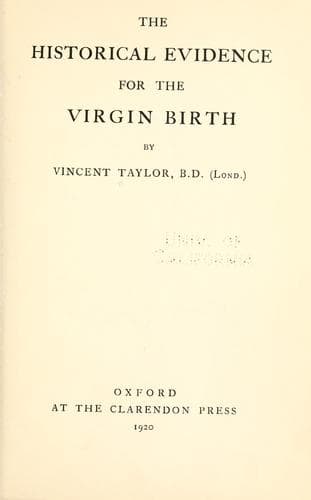
The Historical Evidence for the Virgin BirthTaylor, Vincent
Religion
The Historical Evidence for the Virgin Birth
Taylor, Vincent
Bible. Gospels; Jesus Christ -- Nativity; Virgin birth
In life as in nature there are variations of current and of coast
formation. There are limits, of course, within which this caveat holds
good; but, provided the interval of time is not too great, the view that
St. Luke could begin to write in ignorance of a tradition already known
elsewhere is not self‐condemned. After all, St. Luke himself had access to
much tradition which presumably was unknown to the First Evangelist
(witness St. Luke’s special matter).
Concerning the length of time we can allow the Virgin Birth tradition to
have been already known elsewhere, when St. Luke began to write, there is
room for difference of opinion. If, as we have contended, he became
acquainted with it in the process of writing or immediately afterwards,
the period can scarcely have been considerable. Perhaps it ought to be
estimated in months rather than in years, but to say more would be idle
speculation.
_The farthest point therefore to which we can trace the existence of the
Virgin Birth as a public tradition is some little time previous to the
composition of the Third Gospel._
(3) It is a perfectly fair assumption to make that the public tradition
must have had a _private_ vogue before, and perhaps for some time before,
it became public property. This view becomes especially probable in the
light of what we have just seen, viz. that the spread of the public
tradition among the primitive Christian communities covered an appreciable
period of time. The question of the historical truth of the Virgin Birth
is precisely the question of how far back the private tradition can be
traced; whether it can go back to Mary the mother of Jesus, and whether
satisfactory reasons can be given for a silence which extends beyond the
period covered by the Pauline Epistles and the Second Gospel, and is
broken only at last in the interval which shortly preceded the composition
of the Gospels of Mt. and Lk. In this lies the real historical problem.
_Can the theory of a private authoritative tradition be vindicated?_ There
are several questions which bear upon this problem. They are: (1) The
question of the date of the First and of the Third Gospels; (2) The extent
to which the credibility of the Gospels permits of the possibility of
error; (3) The Alternative Theories of the origin of belief in the Virgin
Birth; (4) The theological aspect of the tradition.
II. The Date of the Gospels in Relation to the Virgin Birth Tradition
The relation in which the question of _the Date of the Gospels_ stands to
the results reached is sufficiently clear. If we could fix the time when
Mt. and Lk. were written, we could determine within comparatively narrow
limits when the Virgin Birth tradition first gained currency. A conclusion
upon this point would materially affect our estimate of the historical
value of the tradition.
Public-domain text, read in full here on John Shaqi.
Reviews
Reviews
No reviews yet
Be the first to share your thoughts on this work.
Elsewhere in the archive
Join the Discussion
Join the discussion
Sign in to leave a comment or review.
Sign InorCreate an account