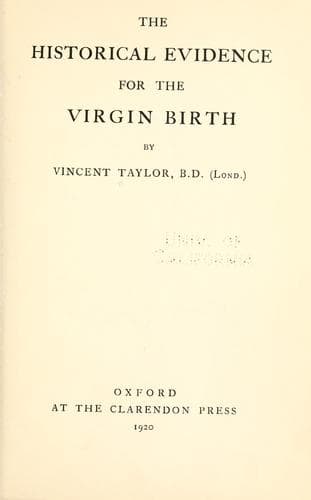
The Historical Evidence for the Virgin BirthTaylor, Vincent
Religion
The Historical Evidence for the Virgin Birth
Taylor, Vincent
Bible. Gospels; Jesus Christ -- Nativity; Virgin birth
It is unfair, because it is neither uncommon nor unreasonable to find men
agreed in rejecting a tradition or belief, and yet at variance in respect
of theories of origin. It is one thing to say that a belief is untrue;
quite another thing to account for its existence. That men agree upon the
one point is more significant than that they differ upon the other. The
view we have mentioned is unwise, because its triumph may be short‐lived.
There is always room for the emergence of a better alternative theory,
which shall combine the excellences, and avoid the weaknesses, of pioneer
attempts.
It does not need a prophet to suggest that the next alternative theory
will be psychological and eclectic. If the tradition is not historical, it
is not likely that we can account for its rise by one factor alone. We may
regard it as established that prophecy alone did not create the tradition,
and that it was not invented on the analogy of non‐Christian myths.
Nevertheless, it may be that Isa. vii. 14, together with the idea that
underlies non‐Christian legends, played an important part in the formation
of the Christian tradition. If the tradition is not historical, its
ultimate origin must be sought in the overwhelming impression which Jesus
left upon believing hearts and minds; in the conviction that from the time
of His Birth, and not only at His Baptism and Resurrection, Jesus Christ
was the Son of God by the anointing of the Holy Spirit. The presumption
that His Birth must have been remarkable would be strengthened by the Old
Testament stories of the birth of Isaac, of Samson, and of Samuel, and
especially by the tradition which already had gathered round the birth of
John. It may also have been stimulated by the belief, found the whole
world over, that the origin of great men is supernatural and miraculous.
Even amongst the Jews the idea was present, that the Messiah’s origin
would be strange, and that no man would know from whence he came (Jn. vii.
27). If there is reason to presuppose such a point of view, we can easily
imagine the electric effect which such a passage as Isa. vii. 14 would
have upon those who studied Old Testament prophecies in the light of their
experience of Jesus. It is vain to object that it is only in the LXX that
this connexion could be established, and that in the Hebrew the word
rendered “virgin” means a young woman of marriageable age. The First
Gospel (i. 23) shows that it was the LXX rendering which was already read,
and doubtless preferred, in the primitive Christian community. Still more
fatuous is it to say, as it has been said again and again, that no Jew
ever interpreted Isa. vii. 14 of the Messiah. As well might we say of
other passages that no Jew would have interpreted them Messianically! The
question is not how Jews regarded Isa. vii. 14, but how it may have
appeared in the eyes of Jews who had come under the spell of Jesus. The
passage cannot have created belief in the Virgin Birth, but it could have
Public-domain text, read in full here on John Shaqi.
Reviews
Reviews
No reviews yet
Be the first to share your thoughts on this work.
Elsewhere in the archive
Join the Discussion
Join the discussion
Sign in to leave a comment or review.
Sign InorCreate an account