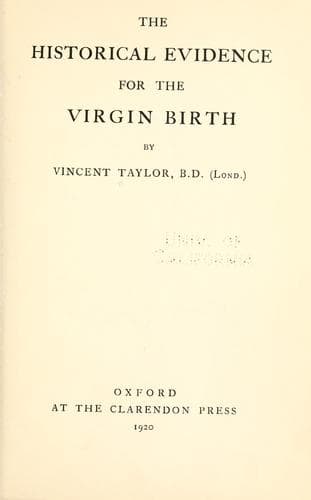
The Historical Evidence for the Virgin BirthTaylor, Vincent
Religion
The Historical Evidence for the Virgin Birth
Taylor, Vincent
Bible. Gospels; Jesus Christ -- Nativity; Virgin birth
Where, then, shall we look for this expression of corporate mind? Not
perhaps again in Consiliar Decrees, though who can say? There is, however,
a corporate mind that finds expression in the affirmations of simple
believers, and in the writings of Christian thinkers the world over. The
affirmations are neither the medley nor the babel they are sometimes
thought to be. There is no colourless uniformity, but there is a real and
growing unity, a harmony in which varied voices blend. No one can survey
Christendom without seeing that everywhere denominational walls become
less and less forbidding, and that every year it is more difficult to
classify Christian thinkers under the prim labels of exclusive schools.
Thought is unbound, but it is not chaotic. The thousand streams fall to
the rivers which flow onward towards the sea that is never full. Those
only may be pessimistic who cannot take long views. We may believe that
the Spirit will yet guide His Church into all the truth. The individual
thinker whose voice breaks the silence will ever be needed. Yet his task
is but a limited one; he too must listen. For unless, beneath his
affirmations, we hear the undertone of a corporate faith and experience,
his voice will be but the echo that rings among the empty hills.
One thing is certain. Whatever the ultimate issue, it must be gain, even
if gain through loss. Whether it be historical or not, the Virgin Birth
tradition must always be full of beauty and of truth.
If, on the one hand, the tradition is involved in the corporate experience
of Christ, if it is congruous with what He was and is, then, admittedly,
the gain is great. For this means increased confidence in the facts which
the Evangelists relate and the primitive community believed: there is no
breach with the past. It means too another foothold in history for the
theological interpretation of the Person of Christ. And these are things
not lightly to be surrendered, save at the command of Truth.
If, on the other hand, the story is a legend of the Christian Faith, that
is not an end. Strangely enough, if the tradition is not historical, it
thereby becomes a valuable piece of Christian apologetic. Who was this
Jesus, we ask, of whom men dared to believe that He was born of a virgin?
The faded wreath is no less the tribute of undying love. That Jewish
Christians could explain the unique divine personality of Jesus by the
miracle of a virgin birth is—if we must solve the problem so—the highest
tribute they could pay. If we find it hard to understand how they could
think of Him in this way, without the warrant of the fact, it may be that
our difficulty is just the measure of our failure to grasp the wonder of
their love. If, in the end, we must call poetry what they called fact, it
will not be because we are strangers to their faith. They too were bound
by the spell of that Transcendent Face in which is the light of the
knowledge of the glory of God.
INDEX
Acts, The, 12 ff., 21.
Public-domain text, read in full here on John Shaqi.
Reviews
Reviews
No reviews yet
Be the first to share your thoughts on this work.
Elsewhere in the archive
Join the Discussion
Join the discussion
Sign in to leave a comment or review.
Sign InorCreate an account