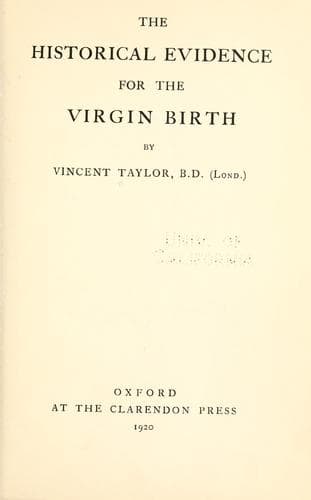
The Historical Evidence for the Virgin BirthTaylor, Vincent
Religion
The Historical Evidence for the Virgin Birth
Taylor, Vincent
Bible. Gospels; Jesus Christ -- Nativity; Virgin birth
Verbal Inspiration, 76 f., 103, 122 f.
Virgin Birth tradition:
alternative theories, 124 ff.
apologetic and spiritual value, 133.
doctrinal aspects, 127 ff.
earliest date of public tradition, 117 ff.
historical problem, 115‐33.
theory of a private tradition, 119, 121, 128.
Völter, 40 n.
Weinel, 36, 69.
Weiss, J., 40 n.
Wellhausen, J., 7.
Wendland, 8 n.
Westcott, B. F., 15 n., 89 n., 108.
Westcott and Hort, 33 n., 57 n.
“Western” Readings, 24‐6, 32‐4, 33 n.
Wise Men, 95.
Zacharias, 43 f.
Zahn, Theodor, 15 n.
Zimmermann, 74 f., 75 n.
[Transcriber’s Note: Obvious printer’s errors have been corrected.]
FOOTNOTES
1 Dr. Orr (_The Virgin Birth of Christ_, 1907, 3rd ed., 1914) says
that in every Pauline reference to the origin of Christ there is
“some peculiarity of expression” (pp. 117 ff., 196). He instances
γενόμενος in Gal. iv. 4, Rom. i. 3, Phil. ii. 7, and speaks of
γεννητός as the word properly denoting “born”. But St. Paul never
uses γεννητός, and Mt. xi. 11 and Lk. vii. 28 are the only instances
in the NT. Moreover, the papyri show that γίνομαι and γενόμενος were
in common use in the sense of “to come into being”, “be born” (cf.
Moulton and Milligan, VGT., 1915, p. 126 a). Canon Box also speaks
of St. Paul’s use of “the out‐of‐the‐way γενόμενον” (_The Virgin
Birth of Jesus_, 1916). “This would harmonise”, he says, “with the
feeling that there was something extraordinary and supernatural
about the birth, which led to its being spoken of in unusual terms”
(p. 149 n.). Not to speak of the papyri, what would these writers
make of Jn. viii. 58, “Before Abraham was (πρὶν Ἀβραὰμ γενέσθαι) I
am”? Was there “something extraordinary” in Abraham’s birth too? For
a view similar to that of Orr and Box see Sweet, _The Birth and
Infancy of Jesus Christ_, p. 237 f.
2 Compare verse 12, “as through one man”, with verse 15, “the grace of
the one man, Jesus Christ”. Cf. also Rom. ix. 5 (and 1 Tim. ii. 5).
3 Cf. H. R. Mackintosh, _The Person of Jesus Christ_, p. 69: “... the
passage [1 Cor. xv. 44‐9] is throughout concerned not in the least
with the pre‐existent but with the exalted Christ. It was only in
virtue of resurrection that He became the archetype and head of a
new race.” Mackintosh says that the Virgin Birth is “not present” in
Gal. iv. 4, “not even hinted at” (p. 528).
4 “The flesh of Christ is ‘like’ ours inasmuch as it is flesh; ‘like’,
and only ‘like’, because it is not sinful: _ostendit nos quidem
habere carnem peccati, Filium vero Dei similitudinem habuisse carnis
peccati, non carnem peccati_ (Orig.‐lat.)” (SH., ICC., Rom., p.
193).
5 For these and other details see Moffatt, INT., pp. 194‐206; also
Harnack, _The Sayings of Jesus_, pp. 229‐52.
6 Cf. Mt. xi. 2 f. = Lk. vii. 18 f.
Public-domain text, read in full here on John Shaqi.
Reviews
Reviews
No reviews yet
Be the first to share your thoughts on this work.
Elsewhere in the archive
Join the Discussion
Join the discussion
Sign in to leave a comment or review.
Sign InorCreate an account