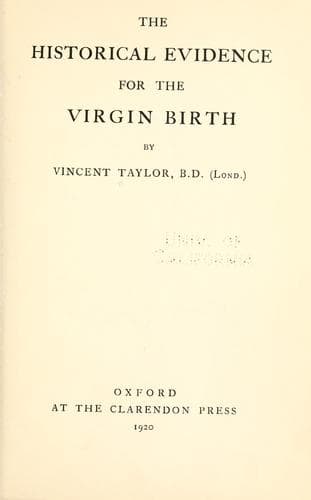
The Historical Evidence for the Virgin BirthTaylor, Vincent
Religion
The Historical Evidence for the Virgin Birth
Taylor, Vincent
Bible. Gospels; Jesus Christ -- Nativity; Virgin birth
75 In Acts xvi. 19, 20 it is said that the owners of the demented girl
“seized Paul and Silas and dragged them into the agora before the
magistrates”. The words which immediately follow are: “and bringing
them to the presence of the praetors, they said....” Ramsay’s
comment is: “The expression halts between the Greek form and the
Latin ... as if the author had not quite made up his mind which he
should employ.... It is hardly possible that a writer, whose
expression is so concise, should have intended to leave in his text
two clauses which say exactly the same thing” (_St. Paul_, p. 217
f.). In reference to Acts xx. 4, 5, Ramsay writes: “In verse 4 we
have probably a case like xvi. 19 f., in which the authority
hesitated between two constructions, and left an unfinished sentence
containing elements of two forms” (ib., p. 289). He adds that the
sentence “perhaps never received the author’s final revision”.
76 Cf. Loofs, _What is the Truth about Jesus Christ?_, p. 122.
77 Speaking of the late appearance of the Virgin Birth tradition G. H.
Box writes (op. cit., p. 137): “Its comparatively late appearance
and primitive character can only be reconciled by the explanation
that it is based upon facts which were for long treasured within a
narrow circle in close contact with our Lord, and which were only
gradually divulged to the Church.” Cf. also Sanday, _Outlines_, pp.
193, 196.
78 Cf. Burkitt, _The Gospel History and its Transmission_, pp. 260, 274
f.
79 Cf. Burkitt (_Evangelion Da‐Mepharreshe_, ii. 260); Moffatt (INT.,
250); Box (_The Virgin Birth of Jesus_, p. 12); Sanday (_Outlines_,
p. 201).
80 So among others Westcott, Burkitt, Box, Allen, Barnard, A. J.
Maclean, Moffatt.
81 _Evan. Da‐Meph._, ii, p. 260. Cf. also Allen (ICC., St. Mt., p. 5);
Box (ib., p. 14); Moffatt (ib., p. 251).
82 “It is merely an embodiment, in genealogical form—a form specially
calculated to appeal to Jewish readers—of the idea that Jesus
belonged, through His relation to Joseph, to the royal family of
David” (Box, ib., p. 15).
83 See Appendix to present chapter.
84 _The N. T. Documents, their Origin and early History_, p. 148. W. C.
Allen (op. cit., p. lxxxv f.) seems to emphasize the more negative
aspects of the writer’s style, but calls attention to phrases and
constructions which are said to be “strikingly characteristic of the
Gospel”. Cf. Moulton, _Gk. Gr._, ii, p. 29.
85 Cf. Burkitt (GHT., p. 184 f.)
86 Sir J. C. Hawkins points out (HS., 2nd Ed., p. 9) that the
“characteristic” words and phrases of Mt. are “used considerably
more freely in these two chapters than in the rest of the book”.
Public-domain text, read in full here on John Shaqi.
Reviews
Reviews
No reviews yet
Be the first to share your thoughts on this work.
Elsewhere in the archive
Join the Discussion
Join the discussion
Sign in to leave a comment or review.
Sign InorCreate an account