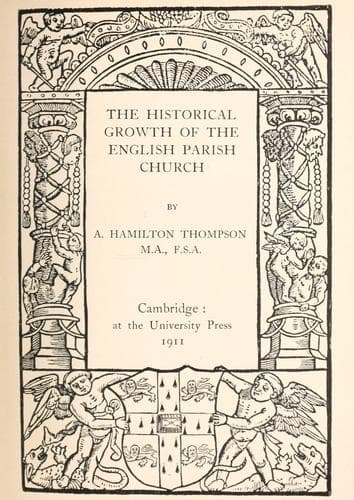
The Historical Growth of the English Parish ChurchThompson, A. Hamilton (Alexander Hamilton)
History
The Historical Growth of the English Parish Church
Thompson, A. Hamilton (Alexander Hamilton)
Church architecture -- England
design, and an ability to plan a parish church as a whole, unequalled
in the previous history of medieval art. They lost their interest
in sculptured detail, because their main concern was with the broad
contrasts of light, shade, and colour, which their large windows and
high walls afforded--contrasts in which there was no use for minute
detail, and the deep under-cutting and delicate carving of the earlier
styles became mere waste of time. The great sheets of coloured glass,
in which, as time went on, painting became of more and more importance,
and large figures beneath tall canopies of white glass took the place
of the smaller subjects and more deeply coloured canopies and grounds
of an earlier time, supplied an effect fully as beautiful as that once
given by the contrasts of bold projections and deep hollows in moulded
arches and carved foliage. The mason in no small degree sacrificed
his skill to the glazier; but, in the service of the glazier, his
power of noble design on a large scale increased. No effect of colour
can well surpass that which is still to be seen in some of our late
medieval churches--the grisaille windows of the chancel at Norbury in
Derbyshire, the late fourteenth century figure glass of the north aisle
at Lowick in Northamptonshire, the fifteenth century east window of
the south aisle at St Winnow in Cornwall, the fourteenth century Jesse
tree, once in St Chad's, and now in St Mary's at Shrewsbury, or the
fifteenth century Jesse tree at Llanrhaiadr-yn-Cynmerch, near Denbigh.
Some of the parish churches of York are almost as rich in glass as the
cathedral itself. But, in those churches which are still so fortunate
as to retain nearly all their medieval glass, like All Saints, North
Street, at York, St Neot in Cornwall, and Fairford, the lack of the
connecting link which the mural paintings between the windows formed
in the colour-scheme is sadly felt. At Fairford, in particular, where
the wall-painting which remains is not near the windows, the glass, in
its frame of cold plastered wall, gives the effect of isolated masses
of almost violent colour, which need to be reduced to their proper
key by the painting of the intermediate wall surfaces. On the other
hand, at Pickering or Raunds, where we have the mural paintings, the
glass is wanting. Often, where painting and stained glass have both
disappeared, as in the chapel at South Skirlaugh, their necessity to
the building forces itself on the attention. Probably, the full value
of stained and painted glass in architectural design, and the relations
which prevailed at the close of the middle ages between the mason and
glazier, can be judged nowhere in Europe better than in King's college
chapel at Cambridge.
Public-domain text, read in full here on John Shaqi.
Reviews
Reviews
No reviews yet
Be the first to share your thoughts on this work.
Elsewhere in the archive
Join the Discussion
Join the discussion
Sign in to leave a comment or review.
Sign InorCreate an account