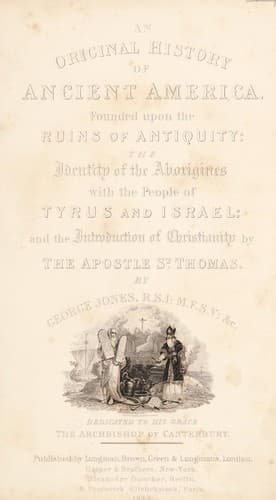
The History of Ancient America, Anterior to the Time of Columbus: Proving the Identity of the Aborigines with the Tyrians and Israelites; and the Introduction of Christianity into the Western Hemisphere By The Apostle St. ThomasJones, George
History
The History of Ancient America, Anterior to the Time of Columbus: Proving the Identity of the Aborigines with the Tyrians and Israelites; and the Introduction of Christianity into the Western Hemisphere By The Apostle St. Thomas
Jones, George
America -- Antiquities; America -- Discovery and exploration -- Phoenician; Indians -- Origin
It is proved (we submit) that the _Sculpture_ in many parts, and
especially at Uxmal, partakes of the _Grecian_ character, while the
_Architecture_ is that of the _Egyptian_. This is a nice
distinction,--but it enables us to strengthen our belief that Egypt,
as a Nation, could not have been the builders, but they must have been
a People (we repeat it, to impress it on the mind of the reader)
having a knowledge of the Nile and her edifices; to this may be
joined, a People having a knowledge, also, of the Greeks, since the
Sculpture at Uxmal is Grecian in design. The Tyrians possessed this
intercourse;--but, it is possible that some few Greeks may have been
of the Colony landing on "the American coast" before the Christian
Æra,--that they may have gladly embraced the occasion, as the only
means of escaping death at the fearful event which caused the
Migration. From the same cause a few Egyptians may have escaped, and
joined the colony in the same manner. The strangers on the Island of
Tyrus, would probably be those who had arrived by water from a
distance,--Egypt was one port of commerce, Ægina another, and
ambitious of maritime fame. Ægina is selected for more than one
reason. It was an Island in direct intercourse with Tyrus, and the
Ægineans were renowned for their general knowledge of the art of
ornamental Sculpture, but not on so grand a scale as that of Athens.
The Ægineans were called _myrmidons_, or _emmets_, from their patient
perseverance in the art of Agriculture and other employments,--and
thence the _Tortoise_ became their National emblem, the slow but sure
progress of that shellfish being a symbol of their industry; it formed
a double emblem; viz., of their industry and marine character. Now it
will be remembered that the Ruins of Uxmal display four _Tortoises_ in
stone Sculpture,--and one was found detached, and buried in the Ruins
of Copan.
Public-domain text, read in full here on John Shaqi.
Reviews
Reviews
No reviews yet
Be the first to share your thoughts on this work.
Elsewhere in the archive
Join the Discussion
Join the discussion
Sign in to leave a comment or review.
Sign InorCreate an account