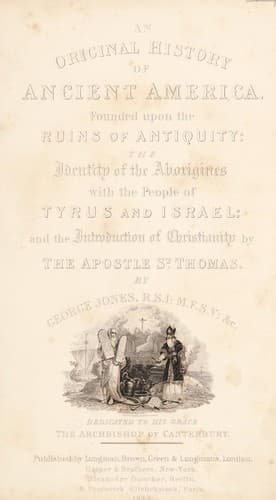
The History of Ancient America, Anterior to the Time of Columbus: Proving the Identity of the Aborigines with the Tyrians and Israelites; and the Introduction of Christianity into the Western Hemisphere By The Apostle St. ThomasJones, George
History
The History of Ancient America, Anterior to the Time of Columbus: Proving the Identity of the Aborigines with the Tyrians and Israelites; and the Introduction of Christianity into the Western Hemisphere By The Apostle St. Thomas
Jones, George
America -- Antiquities; America -- Discovery and exploration -- Phoenician; Indians -- Origin
We will advance another reason for believing that Copan was the first
City built in Mexican America,--viz., the _square_ column (or
obelisk) _only_, is found there,--while in other ruins, excepting
Palenque, the _circular_ is perceptible,--the latter are found at
Mitla and Uxmal,--thus establishing (almost conclusively) that those
cities were of later erection,--for the square column is easier in
formation than the circular,--and the latter is produced from the
former,--and consequently _two columns_ are made in producing the
circular shaft. The square is, also, better adapted, from its facial
character, for the purposes of Sculpture; as illustrated in the
Idol-obelisks at Copan,--and that which would be the simplest in
construction, and giving the greatest facility for its peculiar
adaptation, would naturally be selected by a People for their first
Temple:--yet, reserving to themselves for practice at a future day,
the knowledge possessed in the more refined branches of the Art:--they
subsequently illustrated that superior knowledge at Palenque and
Uxmal. In the conclusion of this section, however, it will be shewn
that the _square style_ of Architecture was essentially Tyrian, and
that it is distinctly visible at Copan and Palenque. An analogy in
regard to antiquity is found from the stuccoing or plaistering of the
walls. This custom in Art is one of the most ancient on record. Mr.
Stephens would infer from the fact of stuccoing that they had a modern
origin, and actually calls it in one place--"_plaister of_ PARIS!" The
custom is mentioned by the first Lawgiver 1451 YEARS before the
Christian Æra!
"And it shall be on the day when ye shall pass over Jordan unto the
land which the LORD thy GOD giveth thee, _that thou shalt set thee up
great stones, and plaister them with plaister: and thou shalt_ WRITE
_upon them all the words of this law_." [Deut. xxvii. 2, 3.]
Here is not only the proof of the ancient custom of stuccoing, or hard
plaistering;--but, also, the fact of _Sculpture_, or _writing upon
Stucco_,--of course in its damp state, and when dry it became, as at
Palenque, "as hard as stone." Again,--It, also, covered the interior
of the palatial walls of Babylon, and was the surface upon which was
traced the handwriting at Belshazzar's Feast,--this was 538 B. C.
"In the same hour came forth fingers of a man's hand, and wrote over
against the candlestick,--upon the _plaister of the wall_ of the
King's palace." [Dan. v. 5.]
Another analogy is found upon this point of art, as being used by both
the ancient Tyrians and the Aborigines;--for the walls of Tyrus were
built of large blocks of stone--not very hard--but protected from the
weather by _hard white-plaister_,--or _stucco_;--the walls of Palenque
seem to be a direct imitation.
Public-domain text, read in full here on John Shaqi.
Reviews
Reviews
No reviews yet
Be the first to share your thoughts on this work.
Elsewhere in the archive
Join the Discussion
Join the discussion
Sign in to leave a comment or review.
Sign InorCreate an account