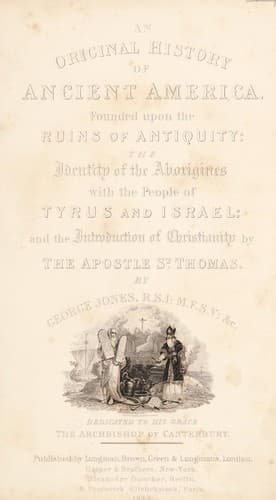
The History of Ancient America, Anterior to the Time of Columbus: Proving the Identity of the Aborigines with the Tyrians and Israelites; and the Introduction of Christianity into the Western Hemisphere By The Apostle St. ThomasJones, George
History
The History of Ancient America, Anterior to the Time of Columbus: Proving the Identity of the Aborigines with the Tyrians and Israelites; and the Introduction of Christianity into the Western Hemisphere By The Apostle St. Thomas
Jones, George
America -- Antiquities; America -- Discovery and exploration -- Phoenician; Indians -- Origin
colours, than the agreement entered into with the Delaware
Tribes, at a treaty concluded at Pittsburgh in 1778. By an
article in that Treaty, _the United-States proposed_ that a State
should be formed, to be composed of the Delawares and the other
Tribes of the North,--and contracted to admit them, when so
formed,--as one of the members of the Union."--[Historical
Discourse, Ohio, 1838.] The above fact of History certainly
proves the anxiety of the Congress, not only to avoid their
enmity, but to provide at a future day _for their continuance as
a People_, and not their "extermination." The same policy of the
United-States has now placed all the Tribes on the West of the
Mississippi,--(for they would form no community founded upon
intermarriage), and there to be protected by the Government of
the United-States against all invaders. In vain shall we search
the Spanish Annals for an instance (in their Mexican Conquests,)
of humanity like these acts of American commiseration and
Christian policy.
In the second sentence of the paragraph quoted from the Literary
Gazette, the Editor has given the identical cause why the Mexican
Aborigines are still found upon their lands,--not as owners, but
as Slaves,--viz., _that they did intermarry_--("enter into a
combination," &c.)--thence the _two_ races are apparent upon the
strongest ground of argument,--viz., Religious principles,--and
which, with all Aborigines are the guides to their actions.
Therefore, the Editor by his remarks upon the Mexican race,
actually solved, though unconsciously, the problem proposed in
his first sentence. In forming a "comparison" between the Spanish
invasion by Cortez, in 1520, and the landing of the
Pilgrim-Fathers in 1620, any writer must fail,--for without
_similitude_ there can be _no comparison_;--_contrast_ is the
word, and never in the history of nations was there a greater
contrast than between the Spanish and Anglo-Saxon races, in their
_motive_ in landing in Mexico and in New-England: but the Editor
has written "_Though the thirst of_ GOLD _was the same in_ BOTH
_instances_, it does appear, and it is melancholy to reflect upon
it, _that something of nobler impulses belonged to the elder_ (or
Spanish) _æra_!" Cortez and Pizarro, and their bands of pirates,
were alone possessed with an unquenchable "thirst of gold,"--it
was "the god of their idolatry,"--even the humane Columbus could
only hold his power with the Spanish Government by sending home
the precious metal,--and when it failed, so declined his
influence; and it at last compelled him to have recourse to
making Slaves of the natives of Hispaniola,--and each had
allotted to him a task of bringing a small bell full of gold from
the mountains, and if they failed, stripes were their punishment;
Public-domain text, read in full here on John Shaqi.
Reviews
Reviews
No reviews yet
Be the first to share your thoughts on this work.
Elsewhere in the archive
Join the Discussion
Join the discussion
Sign in to leave a comment or review.
Sign InorCreate an account