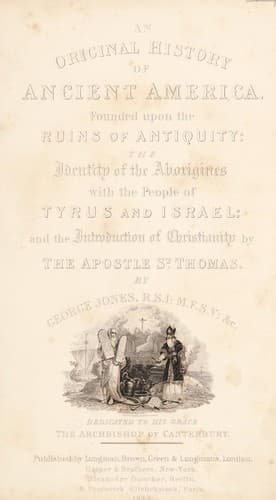
The History of Ancient America, Anterior to the Time of Columbus: Proving the Identity of the Aborigines with the Tyrians and Israelites; and the Introduction of Christianity into the Western Hemisphere By The Apostle St. ThomasJones, George
History
The History of Ancient America, Anterior to the Time of Columbus: Proving the Identity of the Aborigines with the Tyrians and Israelites; and the Introduction of Christianity into the Western Hemisphere By The Apostle St. Thomas
Jones, George
America -- Antiquities; America -- Discovery and exploration -- Phoenician; Indians -- Origin
To conceal the then secret of Ship-building, the Tyrians resorted to
the following means of commercial intercourse with all new, and even
with some of the surrounding nations,--ancient Iberia and
Etruria,--viz., A Tyrian Galley would approach for instance, Britain
or Hibernia,--_only by night_,--the goods were landed, and left
unattended upon the rocks or beach. The Galley would then be rowed to
such a distance, that the natives in the morning could make no
discovery of the manner in which it was built. The Galley, however,
from her high mast, served as a beacon to them, and thence conveyed
intelligence that a cargo had been landed. The natives would then
investigate the goods,--and in return, place by their side, metals and
other commodities supposed by them to be of equal value: _they then_
(from a previous treaty) _would retire out of sight_,--whereupon a
_small boat_ would leave the Galley and approach the shore; the
supercargo would compare the value of the metals or goods offered in
return, and if found to be of an equal barter, the Galley would then
be rowed to the coast, _but at night only_, the exchange-goods would
be placed on board, and having left before the dawn, the secret was
secure. If the natives placed in exchange _less_ than the value, the
Tyrian _boat_ would retire; the Aborigines would again approach and
increase the payment: if they should place _more_ than the value of
the cargo, the honour of the Tyrian merchant (truly 'Singer of the
Sea') was such, that he would not take the overplus, but leave
something of value, set apart, as a compliment to the generous
Islanders. This, without doubt, was the origin of commercial barter,
and founded upon the refinement of honour and honesty.
It may be remarked that a similar custom prevails even at the present
day at Constantinople,--for when a shopkeeper retires for his meals,
or even for a walk, he never closes his door or his windows,--every
article has its price marked, or affixed to it:--the passer-by wishing
to purchase, takes the article and puts in its place the amount in
money;--fraud is not known, for the merchant leaves it to honour, and
that never betrays honesty.
The Bard of Avon must have thought of this scene, and of the
impossibility of its universal application, when in reply to the
announcement "that the _world_ was grown _honest_" he states that the
day of doom must be at hand! What a Millennium will be achieved by
the human race, when every Metropolis shall practise customs in
analogy with that in the City of the Sultan, or those of the
merchant-princes of ancient Tyrus.
The determination of the Tyrians to keep the secret of their
discoveries was as desperate, as their method of concealing the secret
of shipbuilding was ingenious. To illustrate this point of National
Character, an historical anecdote will be given, as being required by
this work,--although the incident occurred some ages later.
Public-domain text, read in full here on John Shaqi.
Reviews
Reviews
No reviews yet
Be the first to share your thoughts on this work.
Elsewhere in the archive
Join the Discussion
Join the discussion
Sign in to leave a comment or review.
Sign InorCreate an account