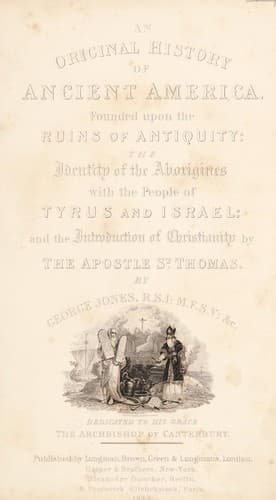
The History of Ancient America, Anterior to the Time of Columbus: Proving the Identity of the Aborigines with the Tyrians and Israelites; and the Introduction of Christianity into the Western Hemisphere By The Apostle St. ThomasJones, George
History
The History of Ancient America, Anterior to the Time of Columbus: Proving the Identity of the Aborigines with the Tyrians and Israelites; and the Introduction of Christianity into the Western Hemisphere By The Apostle St. Thomas
Jones, George
America -- Antiquities; America -- Discovery and exploration -- Phoenician; Indians -- Origin
868 B. C.] Pygmalion ascended the throne of Tyrus 868 years before the
Christian Æra, and from an after action against the life of a near
relation, and that relative even closer allied by marriage,--his
character must have been cruel, bloody, and treacherous.
Acerbas the near kinsman of the Monarch, was not only a Royal Prince,
but also High Priest of the Religion of the Country, and consequently
of superior knowledge and accomplishments. In addition to his station
by birth and intellect (for he was regarded as the wisest man of
Tyrus) he was, also, the richest person in the kingdom, and in default
of issue from the reigning family, was heir to the throne. These
circumstances combined were causes of jealousy to Pygmalion while
Acerbas was yet unmarried. His immense wealth may have been augmented
by the then novel and favourable results of Commerce; for, according
to the Prophet ISAIAH, the Tyrian "traffickers were the honourable of
the earth," and in "the crowning city" her "merchants were _Princes_."
The sister of the King was the renowned Princess, known in poetry and
general history as Dido; but whose name, while yet in Tyrus, was
Eliza,--or Elizabeth,--which name translated from the original
language means _an Oath_,--and as applied to its possessor may be
defined--_an Oath-taker_. It is therefore probable that the attachment
and devotion of the Princess for Acerbas must have commenced in her
earliest days,--because her death (as will be shewn) arose from an
_irrevocable oath_ taken by her of fidelity and widowhood to Acerbas,
should she in the course of nature survive her betrothed. She,
therefore, upon taking the Oath probably received the name of
Elizabeth, and from that circumstance, its definition, and final
consummation completely illustrate our supposition.
There was no Princess of antiquity endowed with more enlarged
attributes of the mind than the Tyrian Elizabeth:--her resolution,
active courage, intellect, and womanly devotion were alike
conspicuous, and consequently she was worthy of being allied to a
Prince possessing the exalted virtue and character of Acerbas. That
the Oath was taken before the marriage is apparent; for the Tyrant did
not prevent the union, but actually promoted it,--and from this
deceitful acquiescence on the part of the King, their nuptials must
have been solemnized amid the rejoicings of the Nation and of the
Throne. [861 B. C.]
The happy bride and bridegroom, in the consummation of their devoted
union, were blinded to the deep scheme revolving in the traitorous
brain of their King and brother.
Public-domain text, read in full here on John Shaqi.
Reviews
Reviews
No reviews yet
Be the first to share your thoughts on this work.
Elsewhere in the archive
Join the Discussion
Join the discussion
Sign in to leave a comment or review.
Sign InorCreate an account