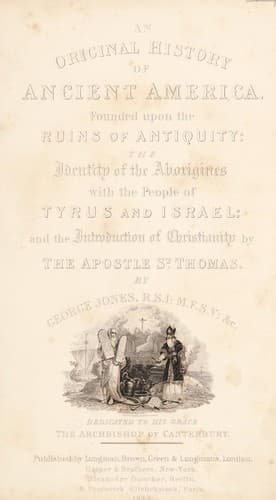
The History of Ancient America, Anterior to the Time of Columbus: Proving the Identity of the Aborigines with the Tyrians and Israelites; and the Introduction of Christianity into the Western Hemisphere By The Apostle St. ThomasJones, George
History
The History of Ancient America, Anterior to the Time of Columbus: Proving the Identity of the Aborigines with the Tyrians and Israelites; and the Introduction of Christianity into the Western Hemisphere By The Apostle St. Thomas
Jones, George
America -- Antiquities; America -- Discovery and exploration -- Phoenician; Indians -- Origin
Upon the successful escape of the Royal and youthful Widow, she
coasted along the Asiatic Shores, and reached those of Africa, and
landed at Utica. There are several reasons for believing that Tyrians
had already reached this spot, as some Historians have suggested. The
following are the arguments here offered for such a conclusion: 1st.
That the general name given to the country at this time was Cadmeia
(_i. e._ Eastern), evidently derived from the word Cadmus, a name
borne only (as stated in the previous pages) by the ancient Tyrian
Chiefs. 2dly. The city, or town at which she first landed was Utica
[_i. e._ ancient], and she named the Capital of her own founding,
Carthage (_i. e. new_ city) apparently merely in contradistinction
to the previous, or "_ancient_" city built by Tyrians. And 3dly. The
fact of going at once to Utica, seems to indicate that her reception
would be certain, and from no people could her sorrows meet with such
sympathy as from her own countrymen. Upon her arrival, and her
misfortunes being made known, it can easily be imagined that every
Tyrian would swear fealty,--while her immense riches, that had been
fatal in one respect,--now enabled her to purchase lands, and build a
citadel and walls for future defence;--her own judgment, and the skill
of her companions, instantly laid the plans for an enlarged and
successful commercial intercourse, which should outrival (as it did
eventually) that enjoyed by her cruel Brother at Tyrus. In addition to
these plans, she formed a scheme of Political action, which, as
applied to the perfect government of a Nation, and which was
consolidated at her death, Aristotle boldly stated to be, the most
triumphant, and perfect, that had ever emanated from the human mind!
Thus the Tyrian Elizabeth founded the kingdom of Carthage, of which
she was at once created Queen:--from this period she is generally
named by Poets and Historians as Dido;--and Virgil, more than any
other writer, has for ages led the student into error in regard to her
true history.
So far as the chief events of Tyrus, or of founding Ancient America,
may be concerned, the future fate of the Queen of Carthage has no
connexion: but, it may be permitted for the pleasure of the writer
(and he dare hope the reader also) to follow this devoted woman to her
death.
Public-domain text, read in full here on John Shaqi.
Reviews
Reviews
No reviews yet
Be the first to share your thoughts on this work.
Elsewhere in the archive
Join the Discussion
Join the discussion
Sign in to leave a comment or review.
Sign InorCreate an account