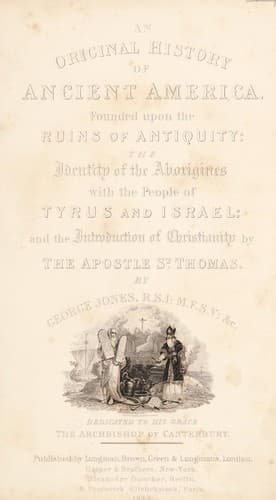
The History of Ancient America, Anterior to the Time of Columbus: Proving the Identity of the Aborigines with the Tyrians and Israelites; and the Introduction of Christianity into the Western Hemisphere By The Apostle St. ThomasJones, George
History
The History of Ancient America, Anterior to the Time of Columbus: Proving the Identity of the Aborigines with the Tyrians and Israelites; and the Introduction of Christianity into the Western Hemisphere By The Apostle St. Thomas
Jones, George
America -- Antiquities; America -- Discovery and exploration -- Phoenician; Indians -- Origin
With this resolution she commanded a funeral pyre to be erected as for
a sacrifice: she then gathered the Ministers of State and her People
around her; and attired in her robes of Royalty, she ascended the
newly-erected Altar of her Nation's freedom! The surrounding
multitude, unconscious of her motives, listened with breathless
attention to her fervent and patriotic eloquence: she urged them to
perpetuate her laws,--to renew their energies for peace or war;--upon
her death to place the reins of government in the firm grasp of wise
men only, whether they now wielded a priestly sceptre or a peasant's
distaff;--as she had no child,--the offspring of her brain they must
receive as her successor! To these points of National glory she
demanded their oath. The vast assembly, gazing from their elevated
Queen to the azure Dome,--and, with one voice, called Apollo, and all
his host, to bear witness, and accept their united and sacred
Oath;--while Echo caught the sound, and bore it even to the
surrounding shores and walls of Carthage, and the People's eyes were
raised to Heaven,--the Queen,--sudden as the flash,--stabbed herself
to the heart! The high-reared Altar became the funeral pyre of
surrounding danger and desolation, for her heroic sacrifice appeased
the claims of the warlike king.
This act of the Queen of Carthage would be viewed in modern days as
madness; but to estimate it correctly, the mind must retire into the
Temples of antiquity, when self-immolation was regarded as the highest
test of pure and disinterested virtue! As without a _similitude_,
there can be no _comparison_, either of Institutions or
Nations,--therefore we can only _contrast_ our own with ancient days.
This difference in language--the mere instrument of truth properly
applied--has been the cause of great injustice to events and
personages of antiquity. We have no just right to _compare_ ourselves
with the ancients, or to measure _their_ morals or virtues by the
standard of our own supposed perfections; and our posterity would be
equally as unjust to themselves as to us, were they, twenty centuries
hence, to record our actions and institutions by their then received
ideas of increased and (truly so) advanced civilization. To be just,
they will in mercy to the faults and sins of their ancestors (_i. e._
ourselves) _contrast_, not _compare_ us.
The suicide--or rather in ancient phrase--self-immolation of the
Queen, was then regarded as the highest virtue; and Cato, the Man of
Rome, in after ages (and at the same Utica where the Princess first
landed), but _imitated_ the act of Woman at Carthage. A _comparison_
between these two acts _can be_ instituted, because, at the time of
their being committed, the ancient world regarded them both in
_similitude_ of virtue. The same as the suicidal deaths of the
Patriots--Brutus and Cassius,--after the fall of Freedom at Philippi.
Public-domain text, read in full here on John Shaqi.
Reviews
Reviews
No reviews yet
Be the first to share your thoughts on this work.
Elsewhere in the archive
Join the Discussion
Join the discussion
Sign in to leave a comment or review.
Sign InorCreate an account