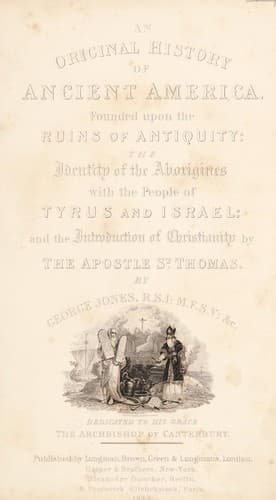
The History of Ancient America, Anterior to the Time of Columbus: Proving the Identity of the Aborigines with the Tyrians and Israelites; and the Introduction of Christianity into the Western Hemisphere By The Apostle St. ThomasJones, George
History
The History of Ancient America, Anterior to the Time of Columbus: Proving the Identity of the Aborigines with the Tyrians and Israelites; and the Introduction of Christianity into the Western Hemisphere By The Apostle St. Thomas
Jones, George
America -- Antiquities; America -- Discovery and exploration -- Phoenician; Indians -- Origin
Here, then, is the fact of a fleet having been built by the Tyrians,
for a foreign king, on the shores of the Red Sea, and for a voyage to
India. Now this Navy was built for Solomon three hundred and
eighty-five years before the time of Pharaoh-Necho, the period now
under contemplation. Why should not the Tyrians build another Navy
upon the borders of the Red Sea, at a later period, for another
nation,--and especially when for an expedition calling forth every
energy of the renowned Navigators? We apprehend that this affirmative,
founded upon a refuted negative, will not now be further questioned
even by the most sceptical reader; and besides, it is more than
probable, that the Tyrians from the time of Solomon to Pharaoh, had a
fleet, or vessels on the Red Sea, and consequently could quickly
prepare for any expedition.
The affirmatives will now be established,--we shall then endeavour to
describe the voyage, the discoveries, and safe return; and then prove
that the entire document has the Seal of Holy-Writ, stamped by the
hands of two contemporaneous Prophets of Jerusalem--JEREMIAH and
EZEKIEL.
Herodotus says, that the Voyage was successfully accomplished,--that
the fleet, pilots, and mariners, were Tyrian.
Let us review the knowledge of this Grecian writer upon the subject.
The expedition is recorded to have taken place 607--604 B. C. This is
evidently an error, and should be 609 to 606,--for Pharaoh instantly
followed his first attempt by the second,--and the first was in 610 B.
C. This last arrangement is also supported by the words of JEREMIAH.
The Greek Historian visited Egypt, and wrote his History about 484 B.
C., deriving his knowledge from personal observation, and from the
Priests of Memphis. The date, therefore, of his writing, is only a
hundred and twenty-two years after the occurrence of the Voyage, and
consequently not at so late a period, that the antecedent truth should
have been lost. Again. He was writing of the Egyptians, to be read to,
and by the Athenians, who were always proud of every glory claimed by
the inhabitants of the Nile, because much of Grecian science and
knowledge had been derived from Egypt,--consequently Herodotus would
have given all the fame to the Egyptians concerning the enterprise, if
he could have done so with honesty; therefore, from the above
reasoning, the truth of his record is manifest,--for to another
nation, to the Tyrians, is he compelled to give the honour of
accomplishing the greatest Naval Expedition mentioned in classic
History.
We will now produce a proof (the most remarkable to be true) of the
accuracy of Herodotus as a writer, and which will establish his
authority to be believed, concerning the subject now under
consideration. In his second Book of History--the Euterpe--he gives
the reigns of the Egyptian Kings down to the Conquest, by Cambyses
the Persian. In the course of his writing, we find a minute
description of the three classes or manners of embalming the Egyptian
mummies.
Public-domain text, read in full here on John Shaqi.
Reviews
Reviews
No reviews yet
Be the first to share your thoughts on this work.
Elsewhere in the archive
Join the Discussion
Join the discussion
Sign in to leave a comment or review.
Sign InorCreate an account