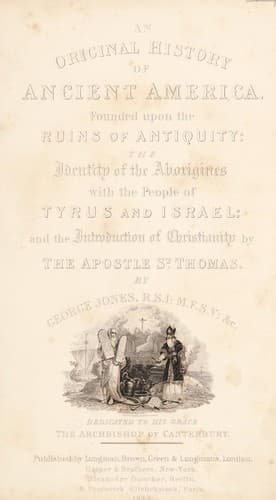
The History of Ancient America, Anterior to the Time of Columbus: Proving the Identity of the Aborigines with the Tyrians and Israelites; and the Introduction of Christianity into the Western Hemisphere By The Apostle St. ThomasJones, George
History
The History of Ancient America, Anterior to the Time of Columbus: Proving the Identity of the Aborigines with the Tyrians and Israelites; and the Introduction of Christianity into the Western Hemisphere By The Apostle St. Thomas
Jones, George
America -- Antiquities; America -- Discovery and exploration -- Phoenician; Indians -- Origin
The Prophet here refers to Cyprus, Crete, Sicily, and Sardinia, for
these are "Isles OF" or "IN" the Mediterranean,--while the Fortunatæ
Insulæ are those denominated "_beyond_" the same Sea,--Britain and
Hibernia were not yet discovered by the Tyrians;--and the only Islands
at this time known to them "_beyond_" the _Mare Internum_, were those
discovered during this celebrated Expedition;--truly so, for being
alluded to by the Sacred writers, proves the importance attached to it
in the days of Prophecy. The Islands discovered, and claimed by the
Tyrians, were additional causes for their fatal pride,--and are,
therefore, the only part of the enlarging Kingdom referred to by
JEREMIAH,--from the apparent fact, that the terrible prediction in
alluding to a recent geographical discovery, would attract the instant
attention, and arouse the fears of the Judæans as well as the Tyrians.
EZEKIEL uttered his celebrated Prophecy concerning Tyrus 588 B. C.,
consequently only _eighteen_ years after the Voyage. He should,
therefore, allude to it, if our previous argument is founded upon just
grounds in reference to ISAIAH'S _not_ writing of it.
EZEKIEL in issuing his malediction against Tyrus, its King, Prince,
and People, gathers in his catalogue of their united powers all that
had made them great, and unrivalled among the nations of the earth. He
commences by stating their knowledge of Shipbuilding and
Navigation,--then the various Kingdoms receiving their Commercial
commodities, and the riches given in return,--progressing in his
description in apparent chronological order,--for this singular fact
is arrived at,--viz., that the last verse referring to the deeds of
the Tyrians, covers distinctly this very Voyage,--and which took place
only 18 years before the Prophecy, and was, therefore, probably their
last great action, before they were besieged and conquered by the King
of Babylon; and which event was only three years after the prediction
of EZEKIEL,--who, in alluding to the last effort for fame by the
Tyrians, and causing additional pride of heart, says--
"_Thy_ ROWERS _have brought thee_ (Tyrus) _into_ GREAT _waters_ [_i.
e._ the Atlantic]--_the_ EAST-WIND _hath broken thee in the midst of
the_ SEAS." [xxvii.]
The word "Sea" in the singular number, and without any pre-nomen as
_Dead Sea_, &c., has already been shewn, and from the same writer, to
have direct reference to the Mediterranean. In the above quotation he
evidently means larger, and collective bodies of "great waters,"--_i.
e. Seas_,--(plural).--Again,--In the same chapter he writes:
"And thou wast replenished [at the Insulæ?] and made very glorious in
the midst of the _Seas_."
He even seems to define the boundary of Tyrus in the Atlantic, for
_Islands_ are distinctly alluded to.
"Thy _borders_ are in the _midst of the Seas_."
And as a distinct contrast of locality; he says of the Capital of the
Mediterranean,--
"What City is like Tyrus, like the destroyed in the midst of the
_Sea_."
Public-domain text, read in full here on John Shaqi.
Reviews
Reviews
No reviews yet
Be the first to share your thoughts on this work.
Elsewhere in the archive
Join the Discussion
Join the discussion
Sign in to leave a comment or review.
Sign InorCreate an account