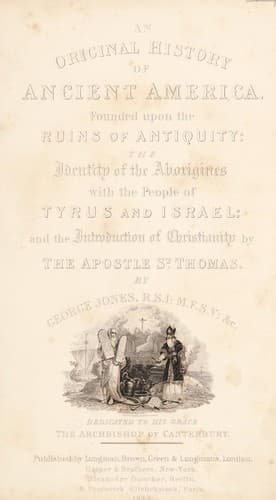
The History of Ancient America, Anterior to the Time of Columbus: Proving the Identity of the Aborigines with the Tyrians and Israelites; and the Introduction of Christianity into the Western Hemisphere By The Apostle St. ThomasJones, George
History
The History of Ancient America, Anterior to the Time of Columbus: Proving the Identity of the Aborigines with the Tyrians and Israelites; and the Introduction of Christianity into the Western Hemisphere By The Apostle St. Thomas
Jones, George
America -- Antiquities; America -- Discovery and exploration -- Phoenician; Indians -- Origin
present, and approaching condition of the home of their
ancestors:--but, upon contemplation of the position of Carthage
itself, they deeply regretted to find, that it precluded even the
remote possibility of sending troops or succour to Tyrus!
Thus Carthage, apparently safe from the present approaches of
Alexander, had her own fears of Invasion; yet had the Senate acceded
to the wish of Tyrus, the two nations, by forming a junction, might
have successfully opposed the further advance of the enemy; but
Carthage had resolved (like Sidon) to save herself by policy, not
warfare.
The Senate of Carthage, therefore, (following the Sidonian example)
deputed an Ambassador to Alexander in order to secure his favour, or
by a tribute to remain in peace. They consequently deputed for the
important and National embassy,--Rhodanus,--a man possessing
extraordinary address and beauty of person, supported by the
fascination of the most accomplished eloquence. The insinuating
manners, and flattery of Rhodanus, (who was presented by Parmenio,)
together with his gallant bearing, had such a magical effect upon the
vain Macedonian, that he instantly cast a friendly eye upon
Carthage:--thus, that Country was saved from invasion by the cheapest,
yet most valued tribute in the mind of the hero of the Granicus,--viz.,
Flattery. Jaddus, the High-Priest of Judæa, subsequently saved
Jerusalem in the same manner, by producing the Prophecy of DANIEL, and
identifying Alexander as "_the_ King of Grecia,"--the "rough goat" of
the prediction.
Rhodanus accompanied the Son of Philip in all his after-expeditions,
and consequently had power, and did transmit to Carthage the plans of
his new Master, who had no suspicion of his flatterer's treachery.
Rhodanus saved his country,--and yet upon his return to Carthage, he
was looked upon as a traitor, from having served in the army of the
Grecian, and was thereupon sentenced to death:--ingratitude and
barbarity carried the decree into execution.
The reply of the Republic to Azelmic's application for troops, cast a
foreboding gloom over the spirits of his subjects. It was too late now
to supplicate to Alexander and receive from him the same terms, as had
been granted to either Sidon or Carthage; for it was known to the
Invader, that a solicitation for an Army had been made to Carthage and
refused; which point was naturally not lost by Rhodanus in his
eloquent appeal; for he represented the denial as having emanated not
so much from fear, or hope of favour, as from admiration and love of
Alexander and his Glory!
Public-domain text, read in full here on John Shaqi.
Reviews
Reviews
No reviews yet
Be the first to share your thoughts on this work.
Elsewhere in the archive
Join the Discussion
Join the discussion
Sign in to leave a comment or review.
Sign InorCreate an account