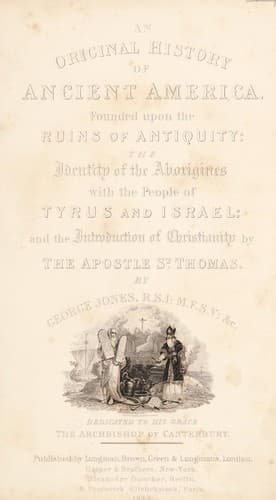
The History of Ancient America, Anterior to the Time of Columbus: Proving the Identity of the Aborigines with the Tyrians and Israelites; and the Introduction of Christianity into the Western Hemisphere By The Apostle St. ThomasJones, George
History
The History of Ancient America, Anterior to the Time of Columbus: Proving the Identity of the Aborigines with the Tyrians and Israelites; and the Introduction of Christianity into the Western Hemisphere By The Apostle St. Thomas
Jones, George
America -- Antiquities; America -- Discovery and exploration -- Phoenician; Indians -- Origin
The four predictions (3d, 4th, 5th, 6th) having reference to the
Alexandrian Siege of Tyrus, distinctly foretels as follows: viz.--The
storming of the capital--the massacre,--the safety of the King,--and
of the King only within the walls. While these points were in
action,--a remnant,--a nation's gleaning,--should be safely
gathered,--that they should be rescued by the means of navigation,--
that they should lift their voices in thanksgiving "from the
sea,"--which as a mother, upon her bosom was to cherish them in
safety! Now all these Prophecies, and their several parts, are proved
by authenticated history to have been accomplished;--no sceptic,
therefore, in regard to the startling character (perhaps boldness) of
this History, can deny to the Author the right to claim and employ a
_seventh_ and a last Prophecy by ISAIAH, to support conclusions of
Tyrian identity in the Western Hemisphere. This last prediction refers
even to the character of the Voyage to be finally taken by the
fugitive "remnant,"--the great distance of their flight,--and that
when they had reached their destination they should sojourn there.
This conclusive Prophecy will be brought forward in its proper place.
The Sidonians and rescued Tyrians now claim attention.
At the moment when the Capital was being desolated by flame and
falchion, and when the walls and gates were "smitten with
destruction," the Sidonian Galleys received on board the fugitive
Families; and from the direct National act of friendship, it must
appear apparent that those saved, Men, Women, and Children, were
Tyrians only;--yet in the confusion, a few Greeks and Egyptians may
have found shelter. This is possible in reference to individuals (but
not to families); for Tyrus being in commercial intercourse with the
Nile and the Archipelago, may have contained some few inhabitants of
Egypt or Greece at the sacking of the City. Amid the noise attendant
upon the entrance of the Macedonian Soldiery, and the screams of the
affrighted populace, the Sidonian vessels, with their fearful freights
escaped unobserved by the invaders; or, if they had been seen by the
enemy, they would not have been pursued; for they were Sidonians,--not
Tyrians,--that is in outward appearance, as manifested by the colours,
or ensigns of their Galleys; and to avoid suspicion, their ships must
have been few,--five or six,--sufficient, however, for the conveyance
of "a Colony from the East."[15]
Public-domain text, read in full here on John Shaqi.
Reviews
Reviews
No reviews yet
Be the first to share your thoughts on this work.
Elsewhere in the archive
Join the Discussion
Join the discussion
Sign in to leave a comment or review.
Sign InorCreate an account