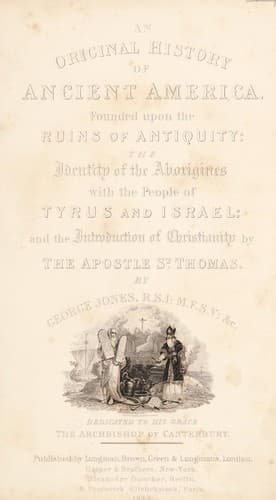
The History of Ancient America, Anterior to the Time of Columbus: Proving the Identity of the Aborigines with the Tyrians and Israelites; and the Introduction of Christianity into the Western Hemisphere By The Apostle St. ThomasJones, George
History
The History of Ancient America, Anterior to the Time of Columbus: Proving the Identity of the Aborigines with the Tyrians and Israelites; and the Introduction of Christianity into the Western Hemisphere By The Apostle St. Thomas
Jones, George
America -- Antiquities; America -- Discovery and exploration -- Phoenician; Indians -- Origin
The next, and only apparent City of refuge was self-protecting
Carthage: but the Senate of that Republic had refused to aid the
Tyrians even in their day of strength; and Alexander's march upon
Jerusalem to resent a supposed offence of the Jews, in rendering
assistance to Tyrus, would be another reason, conjoined with the
sending of Rhodanus, why Carthage would not receive them. The Tyrians,
however, may have been furnished, indirectly, with supplies for a
voyage at Carthage,--_bought by the Sidonians, the owners of the
Galleys_; and in this instance no offence could be entertained by the
agents of the Macedonian, who were watching his interests in the
Republic.
In this terrible dilemma, there was but one Oasis in the watery
Desert, and that was the Tyrian's by right of original discovery;
_this was the group of Islands first landed upon by their Ancestors_,
in their circumnavigation of the Continent of Africa; and which are
designated by JEREMIAH, as "the Isles which are _beyond_ the Sea." To
these truly "Fortunate Islands" it was but natural that the Last of
the Tyrians would turn their thoughts. Since the Alexandrian Deluge
which had overwhelmed their country, in the Sidonian Arks they had
floated above the dangers of the flood; but, like the ravens of the
Deluge, they had wandered to and fro, hopeless of return: yet their
dove of peace, which at first could find "no rest for the sole of her
foot," now brought to their "mental sight" an olive-leaf from their
Island-Ararat "beyond the Sea!"
With heavy hearts, it may be supposed, that they bade farewell for
ever to the Mediterranean. Passing through the Straits of Gibraltar,
and coasting along the western shores of Africa, the snow-crowned Peak
of the chief Island would rise from the Ocean, like a Pharos to
illumine and proclaim their path of present safety. The peculiar
circumstances causing these lands to be revisited by the Tyrians,
would (as before hinted) seem to point directly to the reason of their
original and ancient appellation,--viz., The _Fortunate_ Isles
(Fortunatæ Insulæ). The name, from its very definition, indicates a
place of refuge from foe or wreck, and is, therefore, directly
applicable to the Fugitives. Upon the _chief_ of the Islands, known in
modern times as Teneriffe, the Tyrians and Sidonians first landed. We
establish this apparent fact, upon the ground that the principal
burying-place was here, as proved by the Mummies discovered in the
caverns of the Peak, as stated in the Analogies, and the same species
being found in Peru. They form a distinct and absolute chain across
the Atlantic, uniting the Fortunate Isles with the Western Hemisphere!
[Vol. i., Book i., ch. vii., § 4.] The other Islands of the group were
inhabited at a later day, and without doubt by the Sido-Tyrian
descendants, who became a People known as the Guanches, _i. e._
Freemen; the name itself (as before stated) points to an escape from
Slavery.
Public-domain text, read in full here on John Shaqi.
Reviews
Reviews
No reviews yet
Be the first to share your thoughts on this work.
Elsewhere in the archive
Join the Discussion
Join the discussion
Sign in to leave a comment or review.
Sign InorCreate an account