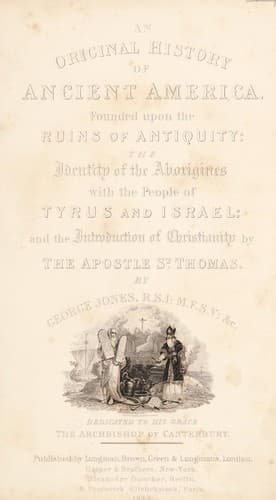
The History of Ancient America, Anterior to the Time of Columbus: Proving the Identity of the Aborigines with the Tyrians and Israelites; and the Introduction of Christianity into the Western Hemisphere By The Apostle St. ThomasJones, George
History
The History of Ancient America, Anterior to the Time of Columbus: Proving the Identity of the Aborigines with the Tyrians and Israelites; and the Introduction of Christianity into the Western Hemisphere By The Apostle St. Thomas
Jones, George
America -- Antiquities; America -- Discovery and exploration -- Phoenician; Indians -- Origin
To establish that the Aborigines of South and Central (_i. e._
Mexican) America, were from the Last of the Tyrian family in Asia, the
following arguments and evidences have been produced: viz.--The
separation of the Aborigines of the Western Hemisphere into two
distinct races, or people;--and that division justified by absolute
contrasts in their moral and physical condition and manners,--in their
political and Religious customs and observances;--and in addition to
these powerful contrasts, is the fact,--that _North_ America possesses
_no Architectural stone ruins_,--while in the Mexican portion of the
Continent, many Cities and Temples have been found.
The great and injurious error of naming the Aborigines--"INDIANS"--was
pointed out,--as well as the Author, and the cause of the misnomer,
and its effects. The title of the first Epoch was then given, and the
arrangement of the several propositions for establishing its truth.
An elaborate argument was next founded upon the important and
interesting question,--"Are the Fine-Arts of sufficient authority, to
be received in evidence, for establishing historical records or
events?" Having produced an answer _con amore_,--and especially
illustrated the answer, by the resuscitation of the Ruins of Rome, we
proceeded in the belief that the argument was conclusive and in the
affirmative.
The fact was then established of the discovery of the ancient Ruins in
Southern or Central America,--viz., at Mitla, Cholula, Uxmal,
Palenque, Quirigua, Ocosingo, Tecpan-Guatimala, Gueguetinango,
Quichē, Copan, Chi-chen, Zayi, Kabah, Espita, Ticol, and
Labnah,--and these severally upon the high authority of the justly
renowned Humboldt,--the Spanish Commissioners Del Rio and
Waldeck,--Dupaix and Galindo,--and last, not least, the enterprising
American Traveller, Stephens,--and his artist-associate,
Catherwood:--and to which list may now be added the name of Norman.
Stephens has investigated other Ruins in Yucatan, but they are
precisely analogous to that of Uxmal. Reference was then made to the
Mexican Paintings preserved in the Vatican, Bologna, and Madrid, and
republished in the folio Volumes by Lord Kingsborough.
Extracts followed from the descriptions of the Ruins of Copan,
Palenque, and Uxmal, with such commentaries as were required, for
illustration of the Architecture and Sculpture, or for detecting
errors.
Public-domain text, read in full here on John Shaqi.
Reviews
Reviews
No reviews yet
Be the first to share your thoughts on this work.
Elsewhere in the archive
Join the Discussion
Join the discussion
Sign in to leave a comment or review.
Sign InorCreate an account