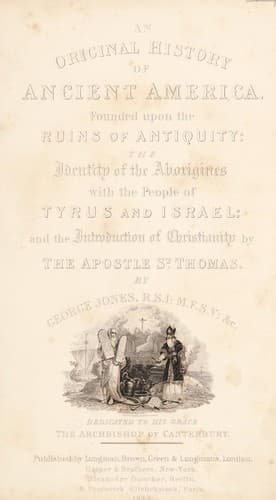
The History of Ancient America, Anterior to the Time of Columbus: Proving the Identity of the Aborigines with the Tyrians and Israelites; and the Introduction of Christianity into the Western Hemisphere By The Apostle St. ThomasJones, George
History
The History of Ancient America, Anterior to the Time of Columbus: Proving the Identity of the Aborigines with the Tyrians and Israelites; and the Introduction of Christianity into the Western Hemisphere By The Apostle St. Thomas
Jones, George
America -- Antiquities; America -- Discovery and exploration -- Phoenician; Indians -- Origin
Having identified the builders of the ancient Cities (from the
Architecture, Analogies, and Traditions) to have been Tyrians, it
followed as a necessity for the commencement of the History of Ancient
America that we must establish the year in which those Tyrians
landed,--still having regard to the antiquity of the Ruins. That the
migration to the Western Hemisphere was _not_ undertaken by the
_Nation_ of Tyrus in its days of _prosperity_ was, and is,
conclusively established by the fact that the voyagers never returned
to announce the accomplishment of the expedition, as they would have
done had they been sent by the King or Nation, as in the case of the
Voyage around Africa. If it had been a National expedition, and they
had under that authority discovered the Western Continent, they must
have returned to Tyrus,--for the absence of the fair portion of our
race would prevent their remaining,--or if they did remain, arguments
in reference to descendants could not be advanced, and therefore an
useless hypothesis in regard to the present history. Since then the
Tyrians did not reach the Western Continent during the period of their
national prosperity,--that fact pointed at once to an æra when decay
or desolation had the ascendancy, and this did not exist until their
last doom and fall, when fire and sword felled the nation--as an
Island-Tree--to the earth,--a few leaves only were rescued by a
friendly gale, and thus escaped the conflagration! That last day of
Tyrus we distinctly pointed out, and from undisputed history, to have
been the 20th of August, 332 years before Christ, which date is not
opposed by the character of the Ruins, or the traditions of the
Aborigines,--but supported by both.
It was then pointed out that the "remnant" saved by the Sidonians
could nowhere land upon the shores of the Mediterranean, from the
natural fear of Alexander's continued vengeance; and the "remnant," or
their descendants, cannot be traced in Europe, Asia, or
Africa,--except upon the Isle of Teneriffe,--as evidenced by the
discovery of the Mummies,--the identity between them and those in
Peru, we mentioned, formed at once a connecting chain across the
Atlantic. The Fortunate Isles discovered by their ancestors were their
only refuge immediately after the desolation of their country,--and
being there, the fears of pursuit would naturally possess them. With
means furnished by the Sidonians, it was submitted that freedom was
assured to them; for, upon leaving the Island of the snow-crowned
Peak, their knowledge of Astronomy, and the power of the Rowers would
aid their voyage,--but apart from those powerful adjuncts, it was
proved that the constant East-Wind would waft them Westward, and with
their double-rudders lashed amidships, their Galleys must "touch at
Florida," on a direct line from Teneriffe, and within the changes of a
moon,--thence the voyage could not be of that duration to compel
return from the want of the means of sustenance.
Public-domain text, read in full here on John Shaqi.
Reviews
Reviews
No reviews yet
Be the first to share your thoughts on this work.
Elsewhere in the archive
Join the Discussion
Join the discussion
Sign in to leave a comment or review.
Sign InorCreate an account