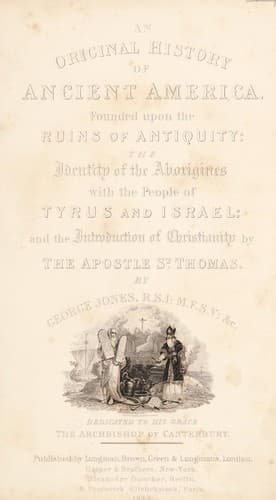
The History of Ancient America, Anterior to the Time of Columbus: Proving the Identity of the Aborigines with the Tyrians and Israelites; and the Introduction of Christianity into the Western Hemisphere By The Apostle St. ThomasJones, George
History
The History of Ancient America, Anterior to the Time of Columbus: Proving the Identity of the Aborigines with the Tyrians and Israelites; and the Introduction of Christianity into the Western Hemisphere By The Apostle St. Thomas
Jones, George
America -- Antiquities; America -- Discovery and exploration -- Phoenician; Indians -- Origin
I stood in the doorway when the Sun went down,
throwing from the buildings a prodigious breadth of shadow, darkening
the terraces on which they stood, and presenting a scene strange
enough for a work of enchantment. This building [_i. e._ in which he
viewed the scene] is sixty-eight feet long. The elevation on which it
stands, is built up solid from the plain, entirely artificial. _Its
form is not pyramidal_, but _oblong_, and rounding, being two hundred
and forty feet long _at the base_, and one hundred and twenty feet
broad, and it is protected all around, _to the very top, by a wall of
square stones_."
The terms of the last sentence are in direct opposition to the
description,--for the elevation is distinctly _pyramidal_. It does not
require a square base only rising from their corners to a central
apex, to be essentially pyramidal,--for a _cone_ is pyramidal, or an
"oblong" rising and diminishing from a broad base; all walls on _an
inclined plane_--no matter at what degree of elevation or declivity,
possess the chief essential of a pyramid.
The cone, oblong, and square,--even a triple-sided or octagonal
pyramid, would be, one and all, correct phrases in the language of
Architecture, to express the character of the pyramid; and are so used
in contradistinction to walls (one or more) of a perpendicular
description,--and the instant such walls lose the facial of the
plumb-line, they become _pyramidal_, from the principle of the wall
rising from its base, and falling to a centre, which, we repeat, is
the chief essential of the pyramid. The number of sides, or none at
all (_i. e._ a cone), has no part in the pyramidal _principle_; as the
key-stone is to the Arch, so the apex is to the Pyramid; but if the
latter _is only half reared_, yet approaching by the inclined walls
_towards an apex_, it is as much a pyramidal structure as if the sides
had reached the apex itself. It is to be regretted that Mr. Stephens
should have been ignorant of the Fine Arts and their rules--(we make
this remark on his own honest confession[2])--because by the confusion
of terms he not only often contradicts himself, but misleads the
general reader in forming conclusions from his graphic descriptions.
[2] Vide J. L. Stephens's Travels in Egypt.
It will, however, be our duty not to pass any such contradiction, but
by the rules of art endeavour to translate the language of the Ruins.
Mr. Stephens has, however, a _motive_ in destroying all resemblance
between these edifices and those of Egypt, _or their neighbours_. In
the next chapter that motive will be unfolded in his own words.
Public-domain text, read in full here on John Shaqi.
Reviews
Reviews
No reviews yet
Be the first to share your thoughts on this work.
Join the Discussion
Join the discussion
Sign in to leave a comment or review.
Sign InorCreate an account