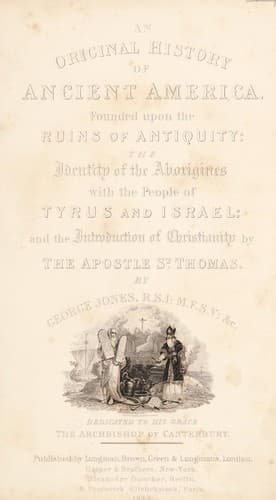
The History of Ancient America, Anterior to the Time of Columbus: Proving the Identity of the Aborigines with the Tyrians and Israelites; and the Introduction of Christianity into the Western Hemisphere By The Apostle St. ThomasJones, George
History
The History of Ancient America, Anterior to the Time of Columbus: Proving the Identity of the Aborigines with the Tyrians and Israelites; and the Introduction of Christianity into the Western Hemisphere By The Apostle St. Thomas
Jones, George
America -- Antiquities; America -- Discovery and exploration -- Phoenician; Indians -- Origin
"On the East side of the structure is a _broad range of stone steps_,
between eight and nine inches high, and so steep, that the greatest
care is required in ascending and descending: of these we counted _one
hundred and one in their places_. _Nine were wanting at the top_, and
perhaps _twenty_ were covered with rubbish at the bottom. At the
_summit_ of the steps is a _stone platform_ four feet and a half wide,
running along the rear of the building. There is no door in the
centre, but at each end a door opens into an apartment eighteen feet
long and nine wide, and between the two is a third apartment of the
same width, and thirty-four feet long. _The whole building is of
stone; inside the walls are of polished smoothness_; outside, up to
the height of the door, the stones are plain and square; above this
line there _is a rich cornice or moulding_, and from this to the top
of the building, _all the sides are covered with rich and elaborate
sculptured ornaments, forming a sort of arabesque_. The style and
character of these ornaments were entirely different from those of any
we had seen before, either in that country or any other; they bore no
resemblance whatever to those of Copan or Palenque, and were quite as
unique and peculiar. The designs were strange and incomprehensible,
very elaborate, sometimes grotesque, but often simple, tasteful, and
beautiful. Among the intelligible subjects, are squares and diamonds
(_i. e._ forms), with busts of human beings, heads of leopards, and
compositions of leaves and flowers, and the ornaments known every
where as _grecques_. The ornaments which succeed each other are all
different; the whole form an extraordinary mass of richness and
complexity, and the effect is both grand and curious; and the
construction of these ornaments is not less peculiar and striking than
the general effect. There were no tablets or single stones, each
representing separately, or by itself, an entire subject; but every
ornament or combination is made up of separate stones, on each of
which _part_ of the subject was carved [sculptured], _and was then set
in its place in the wall_. (?) Each stone by itself was an unmeaning
fractional part; but placed by the side of others helped to make a
whole, which, without it would be incomplete. Perhaps it may, with
propriety, be called a species of sculptured _mosaic_."
Public-domain text, read in full here on John Shaqi.
Reviews
Reviews
No reviews yet
Be the first to share your thoughts on this work.
Join the Discussion
Join the discussion
Sign in to leave a comment or review.
Sign InorCreate an account