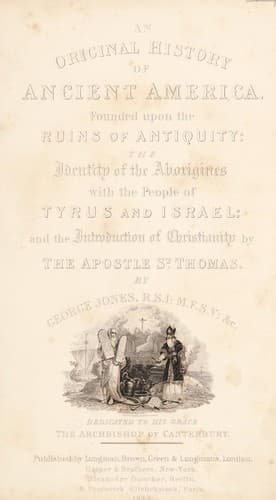
The History of Ancient America, Anterior to the Time of Columbus: Proving the Identity of the Aborigines with the Tyrians and Israelites; and the Introduction of Christianity into the Western Hemisphere By The Apostle St. ThomasJones, George
History
The History of Ancient America, Anterior to the Time of Columbus: Proving the Identity of the Aborigines with the Tyrians and Israelites; and the Introduction of Christianity into the Western Hemisphere By The Apostle St. Thomas
Jones, George
America -- Antiquities; America -- Discovery and exploration -- Phoenician; Indians -- Origin
Mr. Stephens then relates the finding in a ruined Chamber, of "_A beam
of wood_, (_i. e._ the jovillo) about ten feet long, and very heavy,
which had fallen from its place over the doorway. On the face was a
line of characters _carved_ or stamped (?) almost obliterated, but
which we made out to be _hieroglyphics_; and so far as we could
understand them _similar to those at Copan and Palenque_. I cannot
help deploring the misfortune of not being assured of the safety of
this beam. _By what feeble light the pages of American History are
written_! There are at Uxmal no Idols as at Copan,--not a single
stuccoed figure, or carved tablet, as at Palenque. Except this beam of
_hieroglyphics_, though searching earnestly, we did not discover any
one absolute point of resemblance."
The _hieroglyphics_ of all the ruins bind them together as one People;
the difference in the finish of the edifices, and their varied states
of preservation, at once point to different ages in which they were
erected. A principal ornament at equi-distances in the outward cornice
is important, and is thus described by Stephens, and strictly agrees
with the folio work by Waldeck.
"It is the face of a death's-head, _with wings expanded_, and rows of
teeth projecting, in effect somewhat like the figure of _a
death's-head on tombstones with us_. It is two feet across the wings,
and has a stone staple about two feet long, by which it was fastened
to the wall."
In Waldeck's beautiful illustrations of these ruins, some feet below
this winged death's-head, are the cross-bones distinct, and below
these, is a human figure (male) in full maturity, and naked, except
the shoulders and head, standing with his arms _crossed_ "in sorrow's
knot." These Sculptures appear upon, what Waldeck calls the Pyramid of
Kingsborough,--so named, as before stated, in compliment to Lord
Kingsborough, for his costly work upon the Paintings of Mexico. [7
vols. folio.] Well may Stephens say, there are no "Idols" here as at
Copan. _Heathen_ language is not seen in the Sculpture of Uxmal; the
_Christian_ language alone can translate the above emblems of the
Resurrection! The translation of the above Sculpture seems as easy, as
if a DANIEL had already read the handwriting on the wall! as thus--The
human figure, in full life and maturity, together with the sex,
presents mortality; over the figure the _cross-bones_ are placed,
portraying the figure's earthly death; while the skull supported by
expanding wings, (and this Sculpture being placed above those of life
and death,) presents the immortal Soul ascending on the wings of Time,
above all earthly life, or the corruption of the grave! "On tombstones
with us" a better design could not have been formed by Art to enforce
the belief in the Resurrection. The beauty of this subject has led us
into digression, for it belongs to the third volume. Campbell will
apologize for us--
"Coming events cast their shadow before."
Mr. Stephens continues:--
Public-domain text, read in full here on John Shaqi.
Reviews
Reviews
No reviews yet
Be the first to share your thoughts on this work.
Elsewhere in the archive
Join the Discussion
Join the discussion
Sign in to leave a comment or review.
Sign InorCreate an account