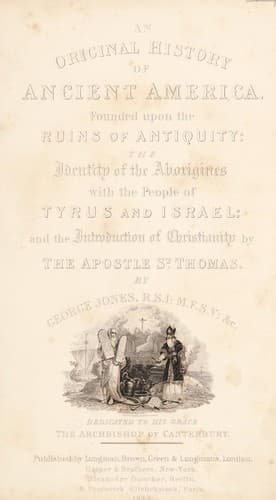
The History of Ancient America, Anterior to the Time of Columbus: Proving the Identity of the Aborigines with the Tyrians and Israelites; and the Introduction of Christianity into the Western Hemisphere By The Apostle St. ThomasJones, George
History
The History of Ancient America, Anterior to the Time of Columbus: Proving the Identity of the Aborigines with the Tyrians and Israelites; and the Introduction of Christianity into the Western Hemisphere By The Apostle St. Thomas
Jones, George
America -- Antiquities; America -- Discovery and exploration -- Phoenician; Indians -- Origin
"In the centre [of the Temple], and opposite the range of steps
leading to the terrace, are three principal doorways. The middle one
is eight feet six inches wide, and eight feet ten inches high; the
others are of the same height, but two feet less in width. The centre
door opens into an apartment sixty feet long, and twenty-seven feet
deep [wide], which is divided into two corridors by a wall three and a
half feet thick, with a door of communication between, of the same
size with the door of entrance. The _plan is the same_ as that of the
Corridor in front of the Palace (?) of Palenque, except that here the
Corridor does not run the whole length of the building, and the back
Corridor has no door of egress. The ceiling forms a _triangular Arch_,
without the Key-stone, as at Palenque."
The term "triangular _Arch_" cannot be admitted by the language of
Architecture; he might as well have written _triangular semicircle_,
terms distinctly opposed to each other. It is essential to notice this
inaccuracy here, otherwise the reader may be under the erroneous
impression, that the _Arch_ does exist in the ancient Ruins in
America,--this is not the fact; but _the entire absence of the Arch,
or its principle_, enables us to form an Architectural conclusion in
reference to their identity; and the fact, _that the Arch does not
exist_ in any of the Ruins of Ancient America, cannot be too forcibly
impressed upon the reader's mind; for it demonstrates that these
buildings were erected _before the Arch was known_, and as a
consequence, is a direct proof of their great antiquity. Mr. Stephens
has already written in reference to Palenque, and previously quoted,
"The builders were evidently ignorant of the principles of the Arch."
"The ceiling, &c.: but, instead of the rough stones overlapping or
being covered with stucco, (as at Palenque) the layers of stones are
bevilled as they rise, _and present an even and a polished_ surface.
Throughout, the laying and the polishing of the stones are as perfect
as under the rules of the best modern masonry. In this apartment we
determined to take up our abode, and _under a roof, tight_ as when
sheltering the heads of its former occupants." * * * * * "We were not
buried in the forest as at Palenque. From every part of the terrace we
looked over a field of ruins." * * * * "From the centre apartment, the
divisions on each wing corresponded exactly in size and finish; and
the same uniformity was preserved in the ornaments. Throughout, the
roof was tight, and the apartments were dry. In one apartment, the
walls were _coated with a very fine plaister of Paris_, (?) equal to
the best seen on walls in this country. (United States) The rest were
all of _smooth polished stone_. There were no paintings, stucco
ornaments, Sculptured tablets, or other decoration whatever."
Public-domain text, read in full here on John Shaqi.
Reviews
Reviews
No reviews yet
Be the first to share your thoughts on this work.
Elsewhere in the archive
Join the Discussion
Join the discussion
Sign in to leave a comment or review.
Sign InorCreate an account