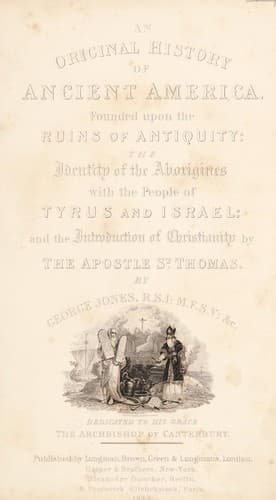
The History of Ancient America, Anterior to the Time of Columbus: Proving the Identity of the Aborigines with the Tyrians and Israelites; and the Introduction of Christianity into the Western Hemisphere By The Apostle St. ThomasJones, George
History
The History of Ancient America, Anterior to the Time of Columbus: Proving the Identity of the Aborigines with the Tyrians and Israelites; and the Introduction of Christianity into the Western Hemisphere By The Apostle St. Thomas
Jones, George
America -- Antiquities; America -- Discovery and exploration -- Phoenician; Indians -- Origin
"I have finished the explorations of ruins,--and here I would be
willing to part, and to leave the reader to wander alone, and at will
through the labyrinth of mystery which hangs over these ruined cities;
but it would be craven to do so without turning for a moment to the
important question. _Who were the people that built these cities?_ I
shall narrow down this question to a ground even yet sufficiently
broad,--viz., a _comparison of these remains with those of the
Architecture and Sculpture of other ages and people_."
It is upon this "ground" of his own choosing that we propose to attack
his manœuvring,--it is the only field of argument where the
necessary truth can be elicited; and he cannot object if his
apparently fortified positions should be attacked, and if not
sufficiently defended, he will not wonder that they should be
demolished or overthrown; and if we cannot succeed in so doing, we are
willing to admit, that his "Conclusions" will be to this work what the
heir-apparent of the Scottish throne was to Macbeth; and the same
words (except one) will speak our frank confession--viz.
"The Prince of Travellers! That is a step
On which I must fall down, _or else o'er-leap_,
For in my way it lies."
He writes:
"I set out with the proposition that they are not Cyclopean, and do
not resemble the works of Greek or Roman."
We admit the negative to the first and last proposition, but not to
the second,--for the sculpture at Uxmal is not only as fine, but
distinctly of a Grecian character: the meander, or square running
border, is essentially Grecian; and even his own description,--viz.,
"Composition of leaves and flowers, and the ornaments known everywhere
as _grecques_." Here is the distinct phrase of his own selection,
brought as evidence against his conclusion on the second proposition.
The engravings in Waldeck's folio work of the same Ruins,
substantiate every description by Stephens, as being correct: the
whole façades have, to the eye, an appearance in regard to the
character of the ornaments, which compels the looker-on to exclaim,
"_Grecian knowledge has been there!_"
"There is nothing in Europe like them. [the Ruins] We must then look
to Asia or Africa. It has been supposed that at different periods of
time, _vessels from Japan and China have been thrown_ UPON THE WESTERN
_coast of America_. [_i. e._ on the Pacific Ocean] The civilization,
cultivation, and science of those countries are known to date back
from a very early antiquity."
The latter sentence does not admit of question; but that the Chinese
or Japanese possessed navigation, with "its means and appliances," at
a period to meet these Ruins, or to cover "a very early antiquity,"
cannot for a moment be sustained by history or even tradition.
Public-domain text, read in full here on John Shaqi.
Reviews
Reviews
No reviews yet
Be the first to share your thoughts on this work.
Elsewhere in the archive
Join the Discussion
Join the discussion
Sign in to leave a comment or review.
Sign InorCreate an account