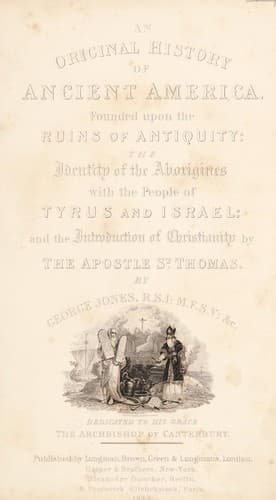
The History of Ancient America, Anterior to the Time of Columbus: Proving the Identity of the Aborigines with the Tyrians and Israelites; and the Introduction of Christianity into the Western Hemisphere By The Apostle St. ThomasJones, George
History
The History of Ancient America, Anterior to the Time of Columbus: Proving the Identity of the Aborigines with the Tyrians and Israelites; and the Introduction of Christianity into the Western Hemisphere By The Apostle St. Thomas
Jones, George
America -- Antiquities; America -- Discovery and exploration -- Phoenician; Indians -- Origin
Mr. Stephens does not claim China and Japan as the nations building
these Cities, but rejects them upon the ground of Architectural
comparison. We instantly join in this decision, and to it add the
impossibility from the want of navigable means; but, says the
Traveller, the supposition is, that they (the vessels) were "_thrown
upon the Western_ coast of America," and thereby expressing that the
arrival of those vessels was _accidental_. We will prove the
impossibility of this,--for any vessel in the North _Pacific_ Ocean,
having left China or Japan, and becoming unmanageable from loss of
rudder, the prevailing _East-wind_ would not only _prevent_ the
vessel from reaching the _Western_ coast of America, _but actually
would drive the ship_ BACK _to China or Japan_! This last sentence is
not given to refute Mr. Stephens, but those writers who may have (as
he states) even "supposed" the possibility of vessels being
accidentally "thrown upon the _Western_ coast of America." Nature
would prevent it. This celebrated "East-wind" we shall have occasion
to analyze and explain, in the investigation of the first voyage
around the Continent of Africa by the Tyrians. In the _Pacific_ Ocean
the East wind would prevent _accidental_ arrival on the shores of the
Western Continent; but in the _Atlantic_ Ocean the same wind would aid
and expedite such an arrival, which, however, would be upon the
_Eastern_, and not the _Western_ coast of America!
"The monuments of India have been made familiar to us. The remains of
Hindu architecture exhibit immense excavations in the rock, either
entirely artificial, or made by enlarging natural caverns, supported
in front by large columns cut out of the rock, with a dark gloomy
interior. Among all these American Ruins there is not a single
excavation. The surface of the country abounding in mountain sides,
seems to invite it; but, instead of being under ground, the striking
feature of these Ruins is, that the buildings _stand on lofty
artificial elevations_; and it can hardly be supposed that a people
emigrating to a new country, with that strong natural impulse to
perpetuate, and retain under their eyes _memorials of home_, would
have gone so directly counter to _National and Religious
associations_."
The reasoning in the latter part of the foregone extract, is founded
upon Nature, and therefore just,--it cannot be shaken,--it cannot be
even assaulted;--we claim this admission, however, for our own
position also, when in the next chapter we bring forward the "memorials
of home," and the "national and religious associations,"--for upon the
Analogies, the corner-stone of this Epoch is founded.
"In Sculpture, too, the Hindus differ entirely. Their subjects are far
more hideous, being, in general, representations of human beings,
distorted, deformed, and unnatural,--very often many-headed, or with
three or four arms and legs thrown out from the same body."
Public-domain text, read in full here on John Shaqi.
Reviews
Reviews
No reviews yet
Be the first to share your thoughts on this work.
Elsewhere in the archive
Join the Discussion
Join the discussion
Sign in to leave a comment or review.
Sign InorCreate an account