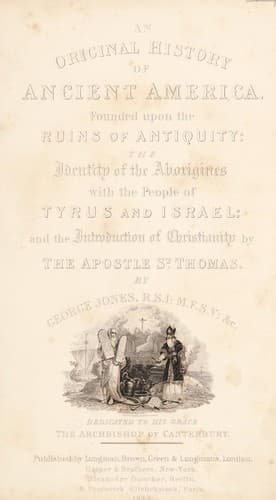
The History of Ancient America, Anterior to the Time of Columbus: Proving the Identity of the Aborigines with the Tyrians and Israelites; and the Introduction of Christianity into the Western Hemisphere By The Apostle St. ThomasJones, George
History
The History of Ancient America, Anterior to the Time of Columbus: Proving the Identity of the Aborigines with the Tyrians and Israelites; and the Introduction of Christianity into the Western Hemisphere By The Apostle St. Thomas
Jones, George
America -- Antiquities; America -- Discovery and exploration -- Phoenician; Indians -- Origin
The Hindu is rejected, and justly, from the want of similitude; the
field is now narrowed for the combat,--the argument is brought, in his
estimation, to _one nation_ only.
"_Lastly_, we come to the Egyptian. The point of resemblance upon
which the great stress has been laid, is the Pyramid. The pyramidal
form is one which suggests itself to human intelligence _in every
country_, as the simplest and surest mode of _erecting a high
structure_ upon a solid foundation."
We grant that the first suggestion of an habitation would be of a
pyramidal character, as instanced in the tents of wandering tribes,
formed by poles rising from a base, more or less broad, and meeting in
a common centre; but we deny that the "pyramidal form" is one
followed "in every country," as a principle for rearing "a high
structure." If it was so generally practised, why is Egypt the _only
country_ where it is found? Why did not China, Japan, Hindustan,
Greece, and Rome practise it? Egypt alone claims it as an
Architectural practice,--the principle of the Pyramid identifies her
amid the wreck of Empires,--it stands out on her _tableau_ of History
as the prominent characteristic,--it was, and is, nowhere found but in
the Nation of the Nile, and now in the Ruins of Ancient America! In
the latter country the Aborigines modified and improved upon the
original; but sufficient is shewn there, even in the base of the
pyramid, to proclaim the association of the builders with Egyptian
_knowledge_; nor does it follow that the Architects of Palenque should
have been, of necessity, Egyptians.
"The pyramidal form cannot be regarded as a ground for assigning _a
common origin to all people_, among whom structures of that
_character_ are found, unless the similarity is preserved in its most
striking features."
The Traveller says, "to all people." [_i. e._ nations]
Why, his own rejections prove that _no other people_ practised the
pyramid but the Egyptian,--upon that fact is he now arguing; for
having failed to find the pyramidal form in all the nations of the
earth, he says, "_Lastly_, we come to the Egyptian."
If in America _an entire_ pyramid, from base to apex, had been found,
he would not have rejected the useless mass, but instantly have
claimed it for Egyptian; _or of that nation only_, having intimate
knowledge of, and association with, that country. Why then reject,--or
rather why does he not bring forward the same reasoning when _the
essential part_ of the pyramid is found there? It will be shewn why he
did not advance it.
"The Pyramids [of Egypt] are peculiar and uniform, and were invariably
erected for the same uses and purposes, so far as those uses and
purposes are known. They are all square at the base, _with steps
rising_ and diminishing until they come to a point."
Public-domain text, read in full here on John Shaqi.
Reviews
Reviews
No reviews yet
Be the first to share your thoughts on this work.
Elsewhere in the archive
Join the Discussion
Join the discussion
Sign in to leave a comment or review.
Sign InorCreate an account