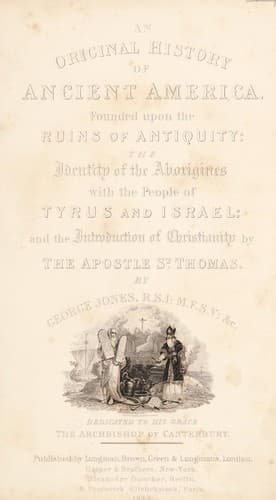
The History of Ancient America, Anterior to the Time of Columbus: Proving the Identity of the Aborigines with the Tyrians and Israelites; and the Introduction of Christianity into the Western Hemisphere By The Apostle St. ThomasJones, George
History
The History of Ancient America, Anterior to the Time of Columbus: Proving the Identity of the Aborigines with the Tyrians and Israelites; and the Introduction of Christianity into the Western Hemisphere By The Apostle St. Thomas
Jones, George
America -- Antiquities; America -- Discovery and exploration -- Phoenician; Indians -- Origin
We have here a distinct and an admitted analogy between the original
characteristic of the Egyptian and the American Pyramids,--proved upon
the very point [the sides] brought forward by him to negate the
proposition, and from his own words. Again; at the base of the Pyramid
of Cephrenes (Egypt), the triangular stones that formed the smooth
sides are still perceptible; so, also, are they to be seen at the base
of the Pyramid of Palenque,--each stone an oracular witness against
his "conclusive consideration." He objects to similitude upon another
ground, and again refutes himself,--viz.:
"The Pyramids of Egypt are all square at the base,--the nearest
approach to this _is at Copan_; but even at that place there is no
entire Pyramid standing alone and disconnected,--_nor one with four
sides complete_, but only _two_, or at most _three sides_, and
intended to form part of other structures."
At Copan (as we have shewn) the very measurement of the base is within
a few feet and (from errors in sum total by different authors) may
justly be regarded as identical in size with the great Pyramid of
Egypt. It has, it is true, but three sides (pyramidal); the fourth
being on the river, consists of a perpendicular wall, identical in
height to the sea-wall of Tyrus. In Egypt they had no river-walls that
were perpendicular. But why does he select Copan only, to prove
whether _four sides_ existed? Why not again review Palenque? His
_motive_ is not concealed with the proverbial ingenuity of his
country; for at Palenque the _four_-sided pyramidal structure is
found, both in his description and in his map of locality, where no
less than _five_ "Casas" (houses) are presented on pyramidal bases,
having distinctly _four sides_, and three of them square; nor is this
all, _the Temple of Palenque itself_ stands on a pyramidal elevation,
having distinctly _four sides_!
As he read a "Congressional" document in the Ruins of Palenque, by the
light of "fire beetles," it would almost appear that he formed his
"_conclusions_" by the same uncertain midnight lamps;--for from such
treacherous and deceptive flames has he illumined the historical
portion of his volumes; but yet the glimmering of the "feeble light"
is sufficient to discover his hidden motive.
We now bring forward a contradiction more astonishing than all the
preceding: and but that his volumes are before us, it would scarcely
be credited from the pen of any critic. Vol. ii., p. 439, he writes--
"Besides, the Pyramids of Egypt are known to have _interior chambers_,
and whatever their other uses, to have been intended and _used as
sepulchres_. These (American), on the contrary, are of solid earth and
stone. No INTERIOR CHAMBERS _have ever been discovered, and probably
none exist_!"
In the _first_ volume (p. 143), in writing of the pyramidal structure
rising from the centre of the Temple of Copan, is the following
description, and which was reserved from the details of that City, to
prove this contradiction.
Public-domain text, read in full here on John Shaqi.
Reviews
Reviews
No reviews yet
Be the first to share your thoughts on this work.
Elsewhere in the archive
Join the Discussion
Join the discussion
Sign in to leave a comment or review.
Sign InorCreate an account