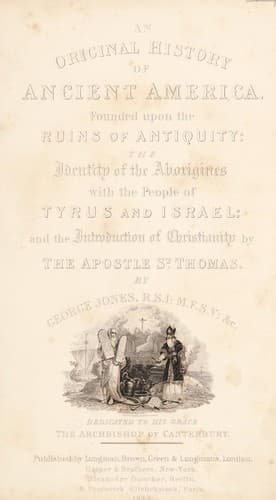
The History of Ancient America, Anterior to the Time of Columbus: Proving the Identity of the Aborigines with the Tyrians and Israelites; and the Introduction of Christianity into the Western Hemisphere By The Apostle St. ThomasJones, George
History
The History of Ancient America, Anterior to the Time of Columbus: Proving the Identity of the Aborigines with the Tyrians and Israelites; and the Introduction of Christianity into the Western Hemisphere By The Apostle St. Thomas
Jones, George
America -- Antiquities; America -- Discovery and exploration -- Phoenician; Indians -- Origin
His "conclusion," which gives no distant antiquity to these Ruins (but
which is absolutely apparent), is somewhat in analogy with that which
may be supposed to have been offered to a travelling Astronomer, by a
homestead-loving Cottager,--who declared that the Moon could not be
_ancient_ and _inhabited_, because the _freshness_ would prevent both
propositions. "Freshness! How so, my good woman?" asked the Newtonian
disciple. "How so!" she replied. "How wise you gentlemen with long
telescopes are!--how so?--why because there is a NEW _moon every
month_, and, consequently, there would not be time enough for people
to be born,--or if they were to grow up like 'plants,' they would be
cut down every month!--and consequently they could not be
_ancient_,--any how!" But to be serious.--Our just pride of native
land! England,--as expressed in "The First Oration upon the Life,
Character, and Genius of Shakspeare,"[5] and our impartial love (as a
Citizen of the United States) for the Nation claiming Washington as
its founder, is too well known and recorded in our humble Oration upon
her History and Independence,[6]--and in public debate, discourses,
and speeches, both in England and America;--together with the feelings
of duty;--and gratitude founded upon hospitality and the Medallic
presentations received in both Countries, to admit even of a question,
as to our resolution to uphold their glory and amity, at home or
abroad,--and that without fear or favour, from foe or friend! It was
_the very spirit of that love_ for the country, which has graced us by
its Citizenship, that led us to detect the erroneous "conclusions" of
Mr. Stephens in reference to these Ruins:--for the errors must be
evident even to himself, should these fervent but honest pages, ever
meet his perusal;--and appreciating as we do, the valuable and
interesting volumes he has given to the Library of "Travels,"--good
nature,--knowledge of the Arts,--united with a justifiable, and a
necessary independence, called forth by the importance of the
subject,--have been the only means employed by us in criticising his
work.
[5] Pronounced at Stratford-upon-Avon, England, before, and at the
invitation of the Royal Shaksperean Institution, April 23, 1836.
[6] Pronounced in the Capital of Virginia, U. S. A., at the
invitation of the Franklin Society, and before the Municipal
Authorities, July 4, 1840.
In his last chapters, he seems to have forgotten what he had written
in his descriptions of the Ruins: and that his "Conclusion" was a
sudden thought,--and, as proved, not founded upon that which preceded.
It could not be otherwise, for
"A change came o'er the spirit of _his_ dream!"
Public-domain text, read in full here on John Shaqi.
Reviews
Reviews
No reviews yet
Be the first to share your thoughts on this work.
Elsewhere in the archive
Join the Discussion
Join the discussion
Sign in to leave a comment or review.
Sign InorCreate an account