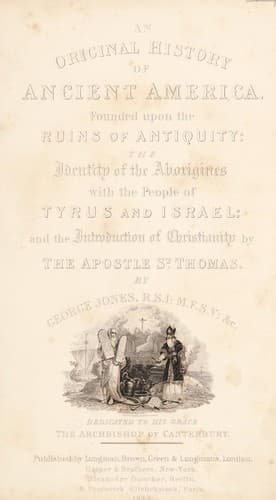
The History of Ancient America, Anterior to the Time of Columbus: Proving the Identity of the Aborigines with the Tyrians and Israelites; and the Introduction of Christianity into the Western Hemisphere By The Apostle St. ThomasJones, George
History
The History of Ancient America, Anterior to the Time of Columbus: Proving the Identity of the Aborigines with the Tyrians and Israelites; and the Introduction of Christianity into the Western Hemisphere By The Apostle St. Thomas
Jones, George
America -- Antiquities; America -- Discovery and exploration -- Phoenician; Indians -- Origin
In Calmet's Dictionary of the Bible, is found a pictorial
representation of the Coins of ancient nations. In the plates giving
those of Sidon and Tyrus (both must be viewed as one) is the figure of
Astartē, surrounded by the words "_The Sidonian Goddess_" in the
old Phœnician characters. She is standing on the fore part of a
galley (emblem of Tyrian navigation)--full robed,--the classic measure
on her head,--a _branch_ in her right hand (emblem of peace and
reward)--and in her left hand _a long Cross_ (emblem of war and
punishment)--the proportions are the same as the sacred one used at
Mount Calvary:--it is upright, and slightly inclines, like a sceptre,
across the inner part of the upper arm of the Goddess. The following
are Calmet's remarks on the Coins.
"No. 4. ASTARTE,--_holding the Cross_;--standing on a Ship (galley):
the measure on her head," &c.
"No. 12. ASTARTE standing in her Temple,--_holding the long Cross in
her hand_--the _shell_, supposed to allude to the Tyrian dye;--in the
exergue,--An Altar (_i. e._ of perpetual fire) burning before the
Temple," &c.
It will be observed that the above manner of alluding to the Cross of
the Tyrian Goddess, is too positive (and with the coins as witnesses)
to admit even of a doubt of its being an emblem of the Tyrians, and
many centuries before the period contemplated by this volume, viz. 332
B. C. They then possessed the Cross, and among the ancients they
appear to have been the only people,--with the exception of the
Egyptians, who probably _copied_ it from the Phœnicians, to
illustrate their own worship of the Moon,--the Egyptian emblem was
thus--(♀)--and this has been falsely called the sacred monogram,--for
the Moon is shewn by the circle--and the Cross was her general emblem.
Astartē carried a Cross merely as an emblem of _punishment_, as
her olive, or palm-branch was emblematical of _reward_,--Solomon
worshipped her, and _her attributes_, upon his leaving the ONE
GOD:--from David descended the husband of The Saviour's Mother, as,
also, the Virgin herself, and _after the Crucifixion, the Cross became
the emblem of Salvation_!--and was no more viewed as a Symbol of
Idolatry, as in the time of David's Son, or of a degraded death as in
the time of Tyberius:--may there not, in this very change of the
character of the emblem, in regard to its attribute of worship,--from
punishment to _atonement_, and by the converted disciples from the
same "chosen people," be a mysterious token of the great precept by
the Divine {GOD},--that from Evil cometh Good? We believe every thing
tending to the Glory of the {CREATOR}: and even if the _monogram_ used
by Constantine did exist centuries before the time of {CHRIST},--but
which we deny,--yet viewing that subject with an eye of faith it would
be found to illustrate the Prophets, and not detract from them or
their Prophecies. We have digressed,--the reader requires no
apology,--the subject will speak for us.
Public-domain text, read in full here on John Shaqi.
Reviews
Reviews
No reviews yet
Be the first to share your thoughts on this work.
Elsewhere in the archive
Join the Discussion
Join the discussion
Sign in to leave a comment or review.
Sign InorCreate an account