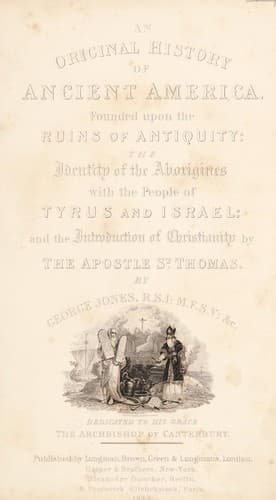
The History of Ancient America, Anterior to the Time of Columbus: Proving the Identity of the Aborigines with the Tyrians and Israelites; and the Introduction of Christianity into the Western Hemisphere By The Apostle St. ThomasJones, George
History
The History of Ancient America, Anterior to the Time of Columbus: Proving the Identity of the Aborigines with the Tyrians and Israelites; and the Introduction of Christianity into the Western Hemisphere By The Apostle St. Thomas
Jones, George
America -- Antiquities; America -- Discovery and exploration -- Phoenician; Indians -- Origin
In the description of the Altar one of the two chief personages holds
in his hand an "instrument" or sceptre--but each of the lesser figures
an "object"--which in the engraving is a _spiral shell_. These shells,
also, illustrate the Nation of Tyrus, for the spiral shell is found
upon nearly all the coins of that ancient country! It was placed on
their coins in honour of the discovery of the secret of the celebrated
colour, called by the ancients,--the Tyrian Dye. That renowned colour
was not made from any earth or mineral, but from the purple murex,--or
the dye _shellfish_. It was first discovered by a Tyrian on the shores
of Tyrus,--who, wandering with his Dog, suddenly observed the mouth of
his faithful companion to be empurpled,--and upon investigation, he
found that it arose from the animal crushing between his teeth, _a
small shellfish_, just then thrown upon the Tyrian beach by the waters
of the Mediterranean. Improving upon the discovery, the Tyrians became
so renowned for their dye used in regal and costly mantles, that in
commemoration of the event, they placed upon their Coins the
_shell_,--nor was the original discoverer forgotten, for upon a Tyrian
Coin (Calmet, No. 16) the Dog is seen approaching the Shell! Some
writers have questioned the manner of the discovery,--but the
last-mentioned Coin confirms the historical account.
The Shell was also adapted to personify the marine character of
Tyrus,--and it being upon the Altar may be viewed as another emblem of
that country,--which, with the Serpents and Eggs, cannot have been
placed there by caprice or accident,--but rather with absolute intent,
having reference to an historical design in the Sculpture. The figures
are all seated "cross-legged in the _Oriental_ fashion." Their very
position then substantiates Montezuma's assertion to Cortez, that his
Ancestors many ages past, come from "_the East_."
One of the chief personages to the "negotiation," as Mr. Stephens
calls the group, has a "Sceptre" in his hand,--and there is none in
the hand of the other King or Cadmus,--(as the ancient Phœnician
Chiefs were called;)--this incident is another proof of the correct
reading of the Act of Amity; for at the time of its performance, Tyrus
had ceased to be a nation--but Sidon had not,--the former had lost all
her powers of safety,--the latter retained them,--and could, and did
extend them to her "Daughter," who is represented as presenting a
Shell,--perhaps the Secret of the "Dye"--as a tributary offering to
her Parent,--who appears on the Altar more elevated than the other
Chief figure. This still further illustrates the fact of the single
sceptre and its application.
Public-domain text, read in full here on John Shaqi.
Reviews
Reviews
No reviews yet
Be the first to share your thoughts on this work.
Elsewhere in the archive
Join the Discussion
Join the discussion
Sign in to leave a comment or review.
Sign InorCreate an account