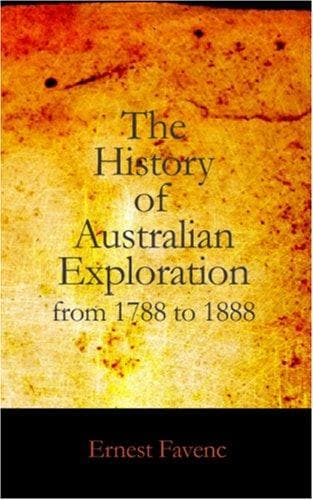
The History of Australian Exploration from 1788 to 1888Favenc, Ernest
History
The History of Australian Exploration from 1788 to 1888
Favenc, Ernest
Australia -- Discovery and exploration
Here Landsborough learnt that during his absence Walker had arrived, and
reported finding the tracks of Burke and Wills on the Flinders. He
therefore determined to go home in that direction, instead of returning
in the steamer, being anxious to see if he could render any assistance.
The party was reduced in number to three whites and three blacks in all,
namely, Messrs. Landsborough, Bourne, and Gleeson, and the three
boys--Jacky, Jemmy, and Fisherman They had a decidedly insufficient stock
of rations when they started the second time, being without tea and
sugar, the VICTORIA not being able to supply them with any.
From the Albert depôt Landsborough made for the Flinders, by way of the
Leichhardt, and arrived at that river on the 19th February. He followed
it up, and was rewarded by being the first discoverer of the beautiful
downs country through which it runs. He named the isolated and remarkable
hills visible from the river Fort Bowen and Mounts Brown and Little. On
the upper part of the Flinders he named Walker's Creek--a considerable
tributary--and from there struck more to the south, towards Bowen
Downs country discovered by himself and Buchanan two years previously.
Here the leader was in hopes of finding a newly-formed station, and
obtaining some more supplies; but the country was still untenanted,
although in one place they observed the track of a dray, and they also
saw the tracks of a party of horsemen near Aramac Creek. They now made
for the Thomson, which is formed by the junction of the Landsborough and
Cornish Creeks, but did not follow it down to the Barcoo, striking that
river higher up. On the Barcoo they had a slight skirmish with the
blacks, who nearly surprised them during the night.
Landsborough was now back in well-known country; some of it, in fact, he
had been over before himself, and from the number of trees they saw
marked with different initials, it was evident that before long stock
would be on its way out. He crossed on to the Warrego, followed that
river down, and on the 21st of May came to the station of Messrs.
Neilson and Williams, where they heard of the fate of Burke and Wills,
the objects of their search. From here the party proceeded to the
Darling, and finally to Melbourne.
On Landsborough's arrival in Melbourne, he found that rumour had
accredited him with being more interested in looking for available
pastoral country than in hunting for Burke and Wills. So far as can be
seen, this accusation was utterly groundless, as there was no saying to
what part of the Gulf Burke and Wills would penetrate, and he was as
likely to meet with traces of them on the Barcoo as well as anywhere
else. With the general belief then current, of the desert nature of the
interior, nobody dreamt that four inexperienced men would have been able
to cross so easily in such a straight line.
The charge lay in a newspaper paragraph that went the round of the daily
papers, an extract from which runs as follows:--
Public-domain text, read in full here on John Shaqi.
Reviews
Reviews
No reviews yet
Be the first to share your thoughts on this work.
Elsewhere in the archive
Join the Discussion
Join the discussion
Sign in to leave a comment or review.
Sign InorCreate an account