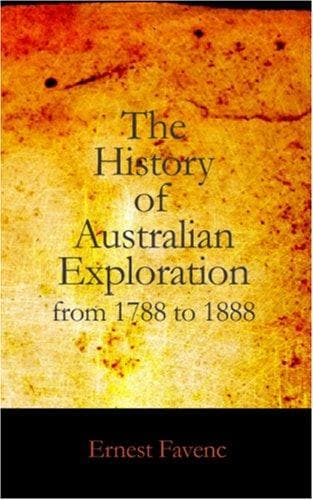
The History of Australian Exploration from 1788 to 1888Favenc, Ernest
History
The History of Australian Exploration from 1788 to 1888
Favenc, Ernest
Australia -- Discovery and exploration
The affairs of the new settlement were now in such a disorganised state
that a commission of enquiry was appointed, and the result was that
Colonel Finnis was removed.
Mr. Goyder then selected Port Darwin as a better situation than that of
Escape Cliffs, and the township was laid out and the residents removed to
there. The establishment of the overland telegraph line soon caused the
town of Palmerston to take permanent importance, which the discovery of
gold in the Northern Territory confirmed.
Western Australia, too, had an unfortunate experience about this time, an
attempt being made to establish a settlement at Camden Harbour. The
country was quite unsuitable, and it was abandoned.
Some fresh interest was now aroused in the unsettled question of the fate
of Leichhardt. A Mr. M'Intyre, who, in 1864, was taking stock from the
Darling to the Flinders River, found himself stopped on the Queensland
border by the stock regulations then in force in that colony. Whilst
detained there he made several short excursions, and examined the country
between the head of the Paroo and the Barcoo, discovering many
well-watered creeks and a lake of considerable size. On his return,
finding that there was still no chance of his being allowed to take his
stock on, he determined to make a trip to the Gulf of Carpentaria and
examine the country he intended taking up.
The party left the Paroo on the 21St June, 1864, and the journey led to
an unexpected discovery. On the way over, M'Intyre found and buried the
bodies of two unfortunate pioneers who had preceded him, Messrs. Curlewis
and M'Culloch. They had. been murdered when asleep by the natives.
Twenty-two days after leaving the Paroo they reached Cooper's Creek, and
then pursued much the same track to the Gulf as that formerly followed by
Burke and Wills, and M'Kinlay. Three hundred miles from the sea, and to
the westward of Burke's track, M'Intyre came upon two old saddle-marked
horses, grazing upon what appeared to be a permanently watered creek. A
short distance to the eastward he found the traces of two camps, and two
trees marked L. From these circumstances M'Intyre concluded that he had
come upon new and important traces of the lost explorer.
On his return to the south, public interest was at once aroused, and,
aided by the championship of Baron Von Mueller, whose enthusiasm in the
cause of discovery never flags, a committee was formed to organise a
party to at once follow up these clues, and try to set at rest the
much-vexed question.
Public-domain text, read in full here on John Shaqi.
Reviews
Reviews
No reviews yet
Be the first to share your thoughts on this work.
Elsewhere in the archive
Join the Discussion
Join the discussion
Sign in to leave a comment or review.
Sign InorCreate an account