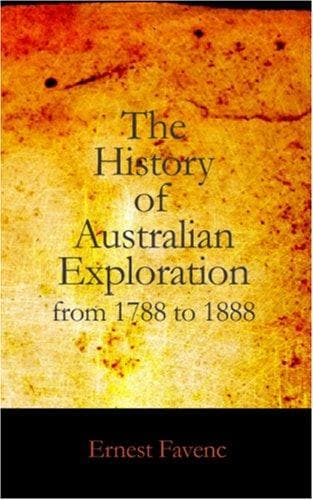
The History of Australian Exploration from 1788 to 1888Favenc, Ernest
History
The History of Australian Exploration from 1788 to 1888
Favenc, Ernest
Australia -- Discovery and exploration
On the 22nd September, he left his fourteenth depôt in the Cavenagh
Range, and started on his return. His course home was by way of the
Musgrave Ranges, where he found a greater extent of good pastoral country
than he anticipated. He discovered and christened the Marryat and the
Alberga, which last river they followed down almost to the telegraph
line, and arrived at Charlotte Waters in December.
Mr. Gosse's exploration did not add much fresh information to what was
already known of the district, but it extended the area of explored
country, and he was enabled to correctly lay down many of the points
discovered by Mr. Giles.
In March, 1874, Mr. Ross and his son, with a well-equipped party,
consisting of another European and three Arabs, having with them sixteen
camels and fourteen horses, started from the neighbourhood of the Peake
Station, on the telegraph line, to endeavour to bridge the desert. He
was, however, compelled to return, although he made another effort, after
reducing the number of his party.
Colonel Warburton having been the first to successfully make his way from
the South Australian border to the settled part of Western Australia,
Forrest was the next to aim and arrive at a successful issue.
Forrest's trip was certainly the most commendable of the two, and by far
the most important in its results. Warburton, with a troop of camels,
reached the Oakover River naked and starving, with but two miserable
animals left. Forrest, with nothing but ordinary pack-horses, crossed the
middle of the continent, where the very heart of the terrible desert was
supposed to exist, and took his men and most of his horses through in
safety.
Forrest, having with him his brother, Alexander Forrest, two white men,
and two natives, left Yuin, then the furthest outside station on the
Murchison, on the 14th of April. Their course at first was along the
upper part of the Murchison River, which he describes as running through
fine grassy flats, good loamy soil, with white gums in bed and on flats,
the water in some of the pools being rather brackish. This description of
country continued for many days, some of the river water being at times
quite salt. On nearing the head of the Gascoyne River, the land was found
to be fine, undulating downs, admirably adapted for sheep or cattle.
On the 21st May, they ascended the watershed of the Murchison, and from
the top had a fine view of their future travelling ground to the
eastward. The country appeared level, with low ranges, but there was an
absence of conspicuous hills--not a promising country for water, but
looking as though good feed would be obtainable.
Public-domain text, read in full here on John Shaqi.
Reviews
Reviews
No reviews yet
Be the first to share your thoughts on this work.
Elsewhere in the archive
Join the Discussion
Join the discussion
Sign in to leave a comment or review.
Sign InorCreate an account