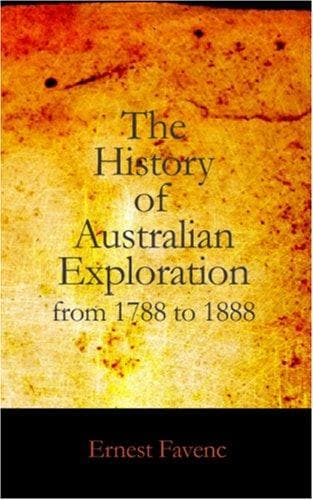
The History of Australian Exploration from 1788 to 1888Favenc, Ernest
History
The History of Australian Exploration from 1788 to 1888
Favenc, Ernest
Australia -- Discovery and exploration
To fairly see what would be the result of bringing a little of the great
sea of hidden waters to the surface, let us take an instance of one of
the tributaries of that great artery of Australia, the Darling. The head
waters of the Warrego rise in latitude 24 deg., and at its very head,
within almost a stone's throw, are large springs, that find their way
down the range into the lowest river. Thence, through coastal lands, to
the eastern sea board. Now had these springs broken out on the higher
level of the Warrego watershed, their waters would have benefited
hundreds of miles of some of the fairest country in Australia, that now
suffers under constant drought.
The preserving and regulating of their waters, after guiding them into
the channels prepared by Nature, would be an after-work greatly assisted
by the varied formation of the country through which their courses would
run.
PART II.
MARITIME DISCOVERIES.
CHAPTER XV
To exhaustively deal with the early maritime discoveries of this
continent would require from the historian a vast power of research, and
especially of caution, in deciding or allotting to any one country the
priority of position as the "first-finders;" and while we know of few
studies affording more intellectual pleasure and enjoyment, we doubt if
the result would even then set at rest the mystery which still enshrouds
those narratives.
Since the commencement of this work, however, the following original
paper has been considered worthy of attention, as it presents the most
reasonable and logical theory yet put forward for the right to consider
the French as the original discoverers, and readers will have pleasure in
following out the various deductions as made by one of our
fellow-colonists, E. Marin La Meslée, Member of the Société de Géographie
Commerciale de Paris, who has, by great research, compiled, in the
following interesting article, the evidence relating to the voyage of the
old Norman navigator, Paulmier de Gonneville, in 1503.
Without endorsing what is here put forward, there is much in its favour,
and it shows a considerable degree of keen argument and cogent reasoning
that, in any case, is a valuable contribution to this department of
literature. Moreover, it may be the incentive for further exploration of
the locality mentioned at some future time, with the view of solving the
secrets of the strange carving and wonderful cave drawings, to which so
much interest has been attracted.
* * * * *
Most of the modern histories of Australia contain, with regard to the
voyage of De Gonneville, the same stereotyped remarks:--
"A claim has been set forth on behalf of a certain French sailor named De
Gonneville, who is stated to have landed on the coast of Australia in
1503, but this claim can easily be dismissed, as there is little doubt
that the country he describes is no other than the island of Madagascar."
Public-domain text, read in full here on John Shaqi.
Reviews
Reviews
No reviews yet
Be the first to share your thoughts on this work.
Elsewhere in the archive
Join the Discussion
Join the discussion
Sign in to leave a comment or review.
Sign InorCreate an account