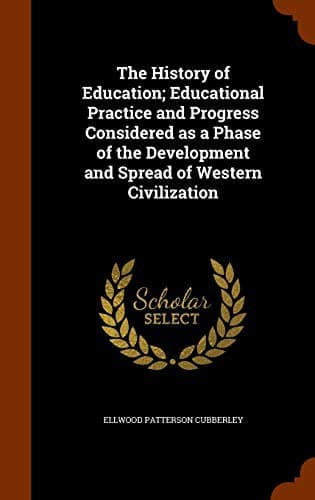
The History of Education: Educational Practice and Progress Considered as a Phase of the Development and Spread of Western CivilizationCubberley, Ellwood Patterson
History
The History of Education: Educational Practice and Progress Considered as a Phase of the Development and Spread of Western Civilization
Cubberley, Ellwood Patterson
Education -- History
THE ORGANIZING WORK OF THE SCHOOLMEN. Peter the Lombard (1100-1160), whose
_Book of Sentences_, mentioned above, had so completely changed the
character of the instruction in Theology, began this work of theological
reorganization. Albert the Great (_Albertus Magnus_, 1193-1280) was the
first of the great Schoolmen, and has been termed "the organizing
intellect of the Middle Ages." He was a German Dominican monk [15], born
in Swabia, and educated in the schools of Paris, Padua, and Bologna. Later
he became a celebrated teacher at Paris and Cologne. He was the first to
state the philosophy of Aristotle in systematic form, and was noted as an
exponent of the work of Peter the Lombard. Thomas Aquinas (c. 1225-1274),
the greatest and most influential scholastic philosopher of the Middle
Ages, studied first at Monte Cassino and Naples, and then at Paris and
Cologne, under Albertus Magnus. He later became a noted teacher of
Philosophy and Theology at Rome, Bologna, Viterbo, Perugia, and Naples.
Under him Scholasticism came to its highest development in his harmonizing
the new Aristotelianism with the doctrines of the Church. His class
teaching was based on Aristotle, [16] the Vulgate Bible, and Peter the
Lombard's _Book of Sentences_. During the last three years of his life he
wrote his _Summa Theologiae_, a book which has ever since been accepted as
an authoritative statement of the doctrines of the Roman Catholic Church.
The character of the organization made by Peter the Lombard and Thomas
Aquinas may be seen from an examination of their method of presentation,
which was dogmatic in form and similar in the textbooks of each. The field
of Christian Theology was divided out into parts, heads, subheads, etc.,
in a way that would cover the subject, and a group of problems, each
dealing with some doctrinal point, was then presented under each. The
problem was first stated in the text. Next the authorities and arguments
for each solution other than that considered as orthodox were presented
and confuted, in order. The orthodox solution was next presented, the
arguments and authorities for such solution quoted, and the objections to
the correct solution presented and refuted (R. 152).
Public-domain text, read in full here on John Shaqi.
Reviews
Reviews
No reviews yet
Be the first to share your thoughts on this work.
Elsewhere in the archive
Join the Discussion
Join the discussion
Sign in to leave a comment or review.
Sign InorCreate an account