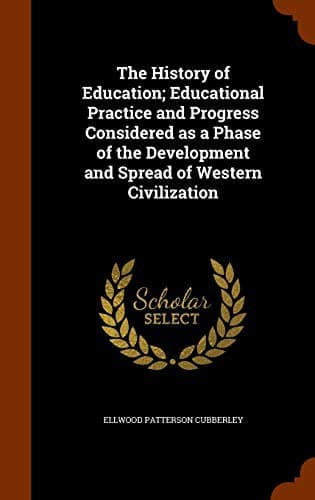
The History of Education: Educational Practice and Progress Considered as a Phase of the Development and Spread of Western CivilizationCubberley, Ellwood Patterson
History
The History of Education: Educational Practice and Progress Considered as a Phase of the Development and Spread of Western Civilization
Cubberley, Ellwood Patterson
Education -- History
The travel to distant lands, the sight of cities of wealth and power, and
the contact with peoples decidedly superior to themselves in civilization,
not only excited the imagination and led to a broadening of the minds of
those who returned, but served as well to raise the general level of
intelligence in western Europe. Some new knowledge also was brought back,
but that was not at the time of great importance. The principal gain came
in the elimination forever of thousands of quarreling, fighting noblemen,
[27] thus giving the kingly power a chance to consolidate holdings and
begin the evolution of modern States; in the marked change of attitude
toward the old problems; in the awakening of a new interest in the present
world; in the creation of new interests and new desires among the common
people; in the awakening of a spirit of religious unity and of national
consciousness; and especially in the awakening of a new intellectual life,
which soon found expression in the organization of universities for study
and in more extensive travel and geographical exploration than the world
had known since the days of ancient Rome. The greatest of all the results,
however, came through the revival of trade, commerce, manufacturing, and
industry in the rising cities of western Europe, with the consequent
evolution of a new and important class of merchants, bankers, and
craftsmen, who formed a new city class and in time developed a new system
of training for themselves and their children.
THE REVIVAL OF CITY LIFE. The old cities of central and northern Italy, as
was stated above, continued through the early Middle Ages as places of
some little local importance. In the eleventh century they overthrew in
large part the rule of their Prince-Bishops, and became little City-
Republics, much after the old Greek model. Outside of Italy almost the
only cities not destroyed during the period of the barbarian invasions
were the episcopal cities, that is cities which were the residences of
bishops.
Public-domain text, read in full here on John Shaqi.
Reviews
Reviews
No reviews yet
Be the first to share your thoughts on this work.
Elsewhere in the archive
Join the Discussion
Join the discussion
Sign in to leave a comment or review.
Sign InorCreate an account