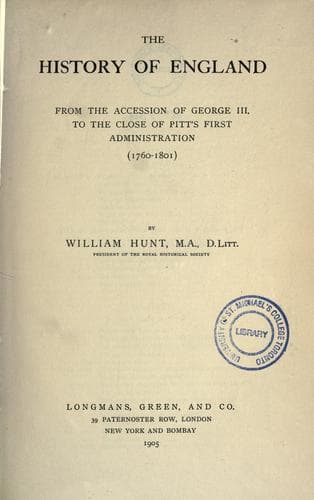
The history of England, from the accession of George III. to the close of Pitt's first administration, 1760-1801Hunt, William
History
The history of England, from the accession of George III. to the close of Pitt's first administration, 1760-1801
Hunt, William
Great Britain -- History -- George III, 1760-1820
they did not endanger its stability.
[Sidenote: _REVOLT IN BENGAL._]
When parliament rose in December Chatham went to Bath for the sake of
his health. In February, 1767, he had a severe attack of gout, and in
March the disease began to affect his mental powers. For the next two
years he was unable to take any part in politics. His effacement left
the ministry without a head. Before his retirement a difference arose in
the cabinet on the affairs of the East India Company. From a simple
trading company it had been raised by the victories of Clive and his
generals to the position of a territorial power. Its affairs were
managed by a court of directors elected annually, and consequently under
the control of the court of proprietors in which every holder of L500
stock had a vote. It proved itself unequal to its new position. Clive
returned to England in 1760, the possessor of a princely fortune, and in
1762 was created Baron Clive of Plassey in the Irish peerage. He was
opposed in the court of directors by a party headed by Sullivan. In
India he was succeeded by Vansittart, and there troubles soon arose,
chiefly from the greed of the company's servants. Mir Jafar, the Nawab
of Bengal, a self-indulgent and unpopular ruler, was deposed by the
council in 1761, and his son-in-law, Mir Kasim, was made nawab in his
place. It was a profitable business, for Mir Kasim spent L200,000 in
presents to the council and ceded to the company the revenues of three
districts, amounting to some L500,000 a year. Yet the exchange of nawabs
proved an unwise step, for Mir Kasim was able and active. He moved his
court from Murshidabad to Monghyr, at a greater distance from Calcutta,
organised an army, and showed that he was ready to resist oppression.
Public-domain text, read in full here on John Shaqi.
Reviews
Reviews
No reviews yet
Be the first to share your thoughts on this work.
Elsewhere in the archive
Join the Discussion
Join the discussion
Sign in to leave a comment or review.
Sign InorCreate an account