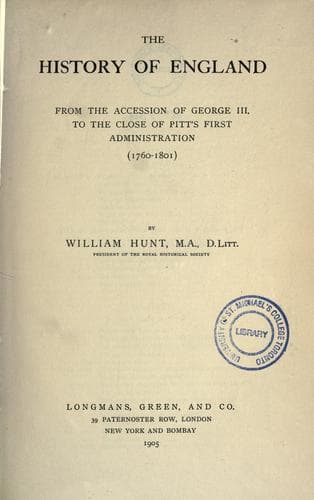
The history of England, from the accession of George III. to the close of Pitt's first administration, 1760-1801Hunt, William
History
The history of England, from the accession of George III. to the close of Pitt's first administration, 1760-1801
Hunt, William
Great Britain -- History -- George III, 1760-1820
Again, the point we have reached marks an epoch, because the rise of
modern radicalism has with fair reason been traced to the struggle over
the Middlesex election in 1769, though in accepting this judgment we
must not forget that the radicalism of 1819 was affected by events of
later dates. In 1769, however, as in 1819, the representatives of the
people were opposed to the will of the people. Where was sovereignty to
reside? In the nation as represented in parliament, or in the nation
external to it? When this question arises it can only be set at rest by
making parliament truly representative of the nation. Accordingly
popular discontent in 1769 was not merely directed against ministers and
measures, it demanded radical changes in the constitutional machinery,
and its demands were expressed by means which, though not
unconstitutional, were not recognised by the constitution, such as
public meetings and associations. Meetings to express discontent and
urge reforms were constantly held, and an association for promoting the
popular demands, called the Bill of Rights Society, was formed by a
clerical demagogue named Horne (afterwards Horne Tooke), Wilkes, Glynn,
and others. Among the changes which they demanded as remedies for the
unsatisfactory state of the representation were annual parliaments, the
exaction of an oath against bribery, and the exclusion from parliament
of holders of places and pensions. At this time, too, constituencies
began to assert a right to control their representatives by sending them
instructions as to their conduct in parliament.
[Sidenote: _CHATHAM AND BURKE AS REFORMERS._]
Public-domain text, read in full here on John Shaqi.
Reviews
Reviews
No reviews yet
Be the first to share your thoughts on this work.
Elsewhere in the archive
Join the Discussion
Join the discussion
Sign in to leave a comment or review.
Sign InorCreate an account