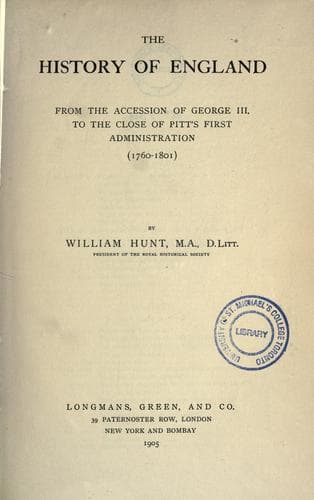
The history of England, from the accession of George III. to the close of Pitt's first administration, 1760-1801Hunt, William
History
The history of England, from the accession of George III. to the close of Pitt's first administration, 1760-1801
Hunt, William
Great Britain -- History -- George III, 1760-1820
It was generally thought that North's administration would be
short-lived. The opposition was strong and apparently united, and it had
a large part of the people at its back. The public expectation was
ill-grounded. The king's influence in parliament was not to be
overborne; as many as 192 members of the house of commons held office
under government.[82] North was a first-rate leader and the king was
industrious and determined. Yet the strength of the ministry was largely
derived from the conduct of their opponents. The violence of the extreme
section of the popular party led to a revulsion of feeling in the
country. In parliament Chatham was not effective, for his declamatory
speeches and dictatorial manner were out of place in the lords; and in
the commons Burke was apt to weary the house, and lost ground through
constant breaches of good taste. Above all, the two parties in the
opposition, the extreme section, with which Chatham had much sympathy,
and the Rockingham whigs, did not work well together. In the spring of
1770 Burke published his _Thoughts on the Causes of the Present
Discontents_, a masterly exposition of the existing political abuses and
of the remedies appropriate to them. Its rejection of proposals for
organic changes in the constitution annoyed Chatham, who declared that
it had done much harm to the cause. He was soon irritated with the whigs
generally. "Moderation, moderation," said he, "is the burthen of their
song;" he would be "a scarecrow of violence to the gentle warblers of
the grove, the moderate whigs and temperate statesmen". He tried to
force the whigs to follow his lead, but Rockingham had no mind to court
Chatham's loud-voiced supporters in the city, or to adopt violent
measures in order to assure the people that he was true to their cause.
Chatham thought it possible that it might be expedient to separate
himself from "so unorthodox a congregation" as the whig party, and
accused Burke and the Rockinghams of a spirit of connexion. So bitter
were his feelings, that he and his friends rejoiced when Dowdeswell and
Burke, "those positive gentlemen," were defeated in an attempt to
vindicate the rights of juries, because they adopted a method of
procedure of which he did not approve; they were, his friend Calcraft
wrote to him, "completely disgraced," and Chatham styled their bill "a
compound of connexion, tyranny and absurdity".[83] While the opposition
was in this distracted state the ministerial party was united. In three
years' time at most opposition in parliament was practically dead, and
the ministry was thoroughly popular in the country.[84]
[Sidenote: _A DIVIDED OPPOSITION._]
Public-domain text, read in full here on John Shaqi.
Reviews
Reviews
No reviews yet
Be the first to share your thoughts on this work.
Elsewhere in the archive
Join the Discussion
Join the discussion
Sign in to leave a comment or review.
Sign InorCreate an account