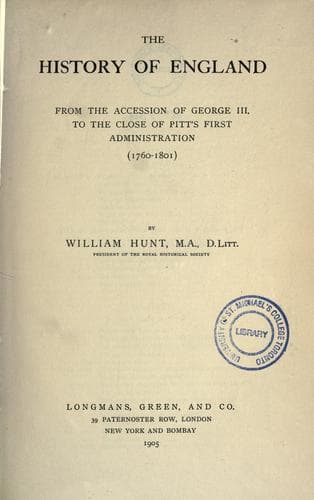
The history of England, from the accession of George III. to the close of Pitt's first administration, 1760-1801Hunt, William
History
The history of England, from the accession of George III. to the close of Pitt's first administration, 1760-1801
Hunt, William
Great Britain -- History -- George III, 1760-1820
Outside parliament a strong party in the city, led by Beckford and
supported by Chatham, was clamorous against the government. In spite of
the disapproval of nearly all the aldermen, Beckford held a meeting of
the livery to complain that the petition of the city with reference to
the Middlesex election had not been answered. The meeting adopted an
arrogantly worded remonstrance to the king, declaring that "a secret and
malign influence" deprived the people of their dearest rights, and
desiring the dissolution of parliament and the removal of evil
ministers. In accordance with a prescriptive right, this remonstrance
was received by the king in person on March 14. George replied to it
with a severe rebuke; the remonstrance was, he said, disrespectful to
himself, injurious to his parliament, and irreconcilable with the
principles of the constitution. The court party was much excited, and at
the Cocoa-tree Tavern, the meeting-place or club of the supporters of
the ministry, talked loudly of impeachments. North wisely held them
back.[85] The house of commons could not allow the insult to itself to
pass unnoticed, and a copy of the remonstrance was moved for. Beckford
and his friends in the house defended it, and Burke passionately urged
the folly and injustice of quarrelling with the city for exercising the
right of petition and remonstrance. North calmed down the heat of the
debate, and pointed out the unconstitutional character of the
remonstrance, which virtually denied the authority of the existing
parliament. The motion was carried, and further debates took place. The
whigs, though firm in asserting the right of petition, disliked the tone
that had been adopted by the city, and an address to the king condemning
the remonstrance was carried by 248 to 94. Chatham was furious. With his
warm approval a remonstrance to the king was sent from Westminster, and
Middlesex and Kent followed suit; but Rockingham's refusal to support
his motion in favour of a dissolution plainly showed him that he could
not force the whigs to adopt violent measures.
[Sidenote: _THE KING AND THE CITY OF LONDON._]
Public-domain text, read in full here on John Shaqi.
Reviews
Reviews
No reviews yet
Be the first to share your thoughts on this work.
Elsewhere in the archive
Join the Discussion
Join the discussion
Sign in to leave a comment or review.
Sign InorCreate an account