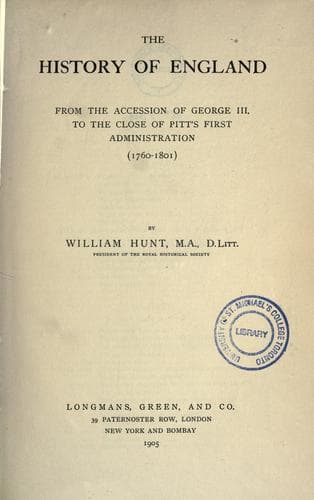
The history of England, from the accession of George III. to the close of Pitt's first administration, 1760-1801Hunt, William
History
The history of England, from the accession of George III. to the close of Pitt's first administration, 1760-1801
Hunt, William
Great Britain -- History -- George III, 1760-1820
On the outbreak of the war the army of Great Britain was on its normal
peace establishment of about 17,000 men, besides the Irish army of
15,235, the garrison of Gibraltar 3,500, and of Minorca 2,500. It was an
amazingly small number, considering the accessions made to the empire by
the late war. George always wished for a larger permanent force; but his
ministers shrank from raising a storm by increasing the estimates or
provoking the popular jealousy of a standing army. Men were wanted at
once. The first reinforcements were obtained from Ireland, and the Irish
parliament agreed that 4,000 men should be drafted out of the country
beyond the number allowed by statute. It soon became evident that the
war required the immediate supply of a far greater number of men than
could be spared from the present establishment or could be raised
quickly. Parliament was not in session, and the king determined to
obtain the services of foreign troops. As Elector of Hanover he lent
2,355 Hanoverians to garrison Gibraltar and Minorca, and so set a
corresponding number of the British garrisons free to be employed in the
war. He sought to hire men from other sovereigns. A proposal made to
Catherine of Russia for the hire of 20,000 men was scornfully declined,
and the States-General refused to sell him their Scots brigade. With the
petty princes of Germany he was more lucky; the Duke of Brunswick, the
Landgrave and the hereditary Prince of Hesse Cassel, and the Prince of
Waldeck were happy to sell their subjects, and agreed to supply 17,742
in return for a liberal payment. These arrangements enraged the
Americans, who spoke of them as though the king was delivering a loyal
people to be massacred by foreign mercenaries. As a matter of fact they
were making war on the king, and he had as good a right to buy troops to
fight in his quarrel as he had to buy cannon. It is on the princes who
sold the blood of their subjects that the disgrace of these transactions
must rest. Frederick of Prussia expressed his disgust at their
greediness in bitter terms, and is said to have jeeringly declared that
when any of the unfortunate men whose lives they were selling passed
through his dominions he would levy toll on them at so much a head as
though they were cattle.
[Sidenote: _EVACUATION OF BOSTON._]
Public-domain text, read in full here on John Shaqi.
Reviews
Reviews
No reviews yet
Be the first to share your thoughts on this work.
Elsewhere in the archive
Join the Discussion
Join the discussion
Sign in to leave a comment or review.
Sign InorCreate an account