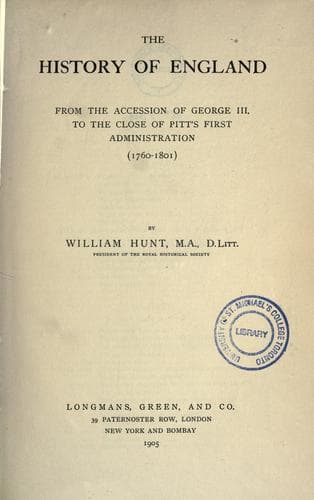
The history of England, from the accession of George III. to the close of Pitt's first administration, 1760-1801Hunt, William
History
The history of England, from the accession of George III. to the close of Pitt's first administration, 1760-1801
Hunt, William
Great Britain -- History -- George III, 1760-1820
Washington's only chance lay in immediate action. The foolish
disposition of the British army gave him an opportunity. Their central
cantonments, nearest to the enemy, were weak. Trenton was held by only
1,200 Hessians; their discipline was relaxed, they were hindered by
difference of language from gaining intelligence, and they lived in
careless security. Washington was reinforced by Lee's troops and by
three regiments from Ticonderoga, which Carleton's inaction had rendered
available for service in the south. On the night of December 25 he
crossed the Delaware, and before daybreak took Trenton by surprise. The
startled garrison could make no resistance; about 200 escaped and 918
were taken prisoners. Of the Americans only two were killed and six
wounded. Cornwallis, who was on the point of embarking for England,
hastened back to the Jersey army. Washington avoided a general
engagement, defeated two regiments employed in an operation for the
defence of Princeton, and before the middle of January, 1777, compelled
the British by a series of well-conducted movements to evacuate West
Jersey and withdraw to Brunswick and Amboy, where they went into
quarters. The king's troops, British and German, committed many
excesses, plundering friends and foes alike; and the inhabitants,
indignant at their conduct, took advantage of Washington's success and
turned against them. Many joined Washington's army. The British were in
the midst of a hostile population, and though they had communication
with New York by water, were almost besieged by land, for their supplies
were constantly intercepted. The Jersey loyalists were left to the
vengeance of their neighbours and were mercilessly plundered. Many of
them fled to New York where several thousand provincial troops were
embodied. Howe remained inactive at New York until the spring, and
Washington also stayed quietly at his headquarters at Morristown.
[Sidenote: _A PARTIAL SECESSION FROM PARLIAMENT._]
Parliament was opened on October 31, 1776. An amendment to the address
referring to American affairs was defeated in the lords by 91 to 26 and
in the commons by 242 to 87. The news of the victory at Brooklyn--"the
terrible news," as Fox indecently called it--and of the occupation of
New York strengthened the ministers; and on a motion to revise the acts
by which the Americans considered themselves aggrieved, the minority in
the commons sank to 47. Depressed by the exhibition of their weakness,
the Rockingham section ceased to attend parliament except on the
occasion of private bills in which they were interested. Petulance and a
false notion of dignity led them to neglect their duty to their country
and their party. Their conduct was blamed by other whigs, and their
secession, though it occasioned discord in the opposition, did not
paralyse its efforts. Fox, by that time its most effective orator, went
off to Paris, and the king advised North to proceed with as much
business as possible in his absence.
Public-domain text, read in full here on John Shaqi.
Reviews
Reviews
No reviews yet
Be the first to share your thoughts on this work.
Elsewhere in the archive
Join the Discussion
Join the discussion
Sign in to leave a comment or review.
Sign InorCreate an account