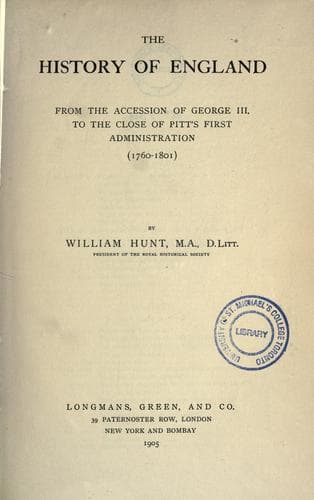
The history of England, from the accession of George III. to the close of Pitt's first administration, 1760-1801Hunt, William
History
The history of England, from the accession of George III. to the close of Pitt's first administration, 1760-1801
Hunt, William
Great Britain -- History -- George III, 1760-1820
Besides the stores sent by Beaumarchais and 1,000 livres in cash, France
helped the Americans by neglecting to prevent the violation of her
neutrality by their ships. Although the Americans could not dispute with
Great Britain on the sea, they had a few ships built by congress, more
belonging to the maritime provinces, and a vast number of privateers.
These ships did much damage to British trade. Already they hovered
about the coasts of England and Ireland, and were so dangerous to our
merchant vessels that merchants embarked their goods on foreign ships to
avoid the risk of capture. By the end of 1778 nearly 1,000 merchant
ships were taken by American privateers. Some of these privateers were
fitted out in French ports, brought their prizes into them, and sailed
from them again on fresh expeditions. Our ambassador, Lord Stormont,
complained vigorously of these open breaches of neutrality, and at last
the French government took some measures to stop them. The opposition in
parliament constantly insisted that, if the war went on, France and
Spain would certainly take part with the Americans. The government could
no longer ignore, though it still strove to discredit, the danger of
foreign intervention. The king's speech at the opening of parliament on
October 20, 1777, took note of the naval preparations of the two powers
and recommended an augmentation of the navy. Tidings of Burgoyne's
disaster reached Europe on December 2. Vergennes at once informed the
American agents that his master would make a treaty with them. The
alliance was concluded on February 6, 1778; it was agreed that, in the
event of war between France and England, neither of the contracting
parties should make peace without the consent of the other or until the
independence of the United States should be assured by treaty. France
renounced all claim to Canada. If taken from England, it was to belong
to the United States, while all conquests in the West Indies were to
belong to France. Spain at this time declined to join in the alliance.
That a treaty was signed was soon generally believed in England; it was
officially declared by France on March 13. War between Great Britain and
France began in the summer.
Public-domain text, read in full here on John Shaqi.
Reviews
Reviews
No reviews yet
Be the first to share your thoughts on this work.
Elsewhere in the archive
Join the Discussion
Join the discussion
Sign in to leave a comment or review.
Sign InorCreate an account