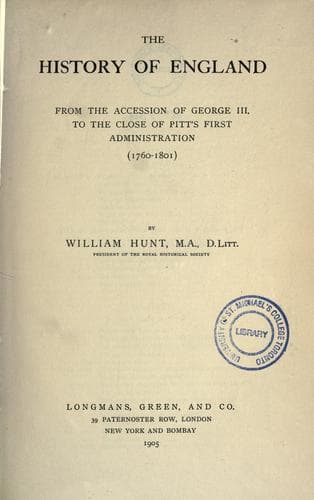
The history of England, from the accession of George III. to the close of Pitt's first administration, 1760-1801Hunt, William
History
The history of England, from the accession of George III. to the close of Pitt's first administration, 1760-1801
Hunt, William
Great Britain -- History -- George III, 1760-1820
Energetic as the opposition was in attack, it was not united in policy.
Chatham, zealous for England's imperial position, declared that he would
never consent to American independence. There was yet time to make peace
with the people of our own blood and so be ready to meet our foreign
foes. He proposed a cessation of hostilities and an immediate offer of
terms. All that the Americans could demand as subjects should be
granted, and overtures made to them on the basis of political dependence
and the navigation act; that is, their trade should still be regulated
by duties. They would, he was sure, accept these terms. If not, they
must be compelled to obedience. The Americans would certainly not have
treated on his basis. Chatham had repeatedly declared that it was
impossible for us to conquer them; yet he proposed that if his basis
were rejected we should use coercion after putting ourselves at a
disadvantage by withdrawing our army. Still, as there were many
Americans besides the loyalists who would have welcomed conciliation,
and as the proposed French alliance was unpopular, it is just possible
that had Chatham himself been prime minister some way might have been
found which, while securing to America virtual independence such as
England's self-governing colonies now enjoy, might have prevented the
severance of the bond. On the other hand, the Rockingham party held that
we should prevent the alliance between France and America by
acknowledging American independence. This division between the two
sections of the opposition set them in hostile camps.
Public-domain text, read in full here on John Shaqi.
Reviews
Reviews
No reviews yet
Be the first to share your thoughts on this work.
Elsewhere in the archive
Join the Discussion
Join the discussion
Sign in to leave a comment or review.
Sign InorCreate an account