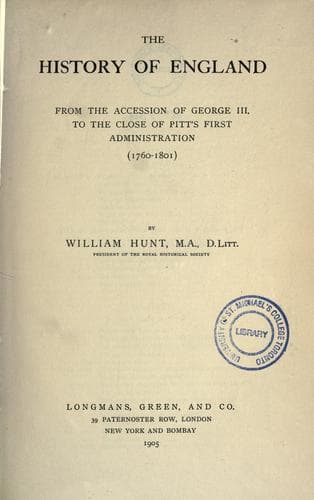
The history of England, from the accession of George III. to the close of Pitt's first administration, 1760-1801Hunt, William
History
The history of England, from the accession of George III. to the close of Pitt's first administration, 1760-1801
Hunt, William
Great Britain -- History -- George III, 1760-1820
As soon as war was declared with the Dutch, orders were sent to Rodney,
who returned from America to the Antilles at the end of 1780, to capture
St. Eustatius. From a mass of barren rock this Dutch island had suddenly
become a place of first-rate commercial importance. In order to supply
our West India planters with food for their slaves, parliament allowed
trade to be carried on there with the Americans. In St. Eustatius the
goods of all nations were bought and sold; and British and French
planters, American dealers and Dutch merchants traded with one another
as in a time of peace. English planters and merchants also used it as a
place of deposit, believing that their goods would be safer there than
in their own islands, which were open to attacks from the French. The
wealth of the island was prodigious; the rents of the dwellings and
warehouses hastily constructed on it amounted to a million a year; it
had, as Burke said, risen from the waters like another Tyre to become
the mart of the world. Like the British island of Nassau during the
American civil war, it carried on along with legitimate commerce a brisk
contraband trade, and its merchants supplied the Americans and French,
their principal and most favoured customers, with vast quantities of
naval stores and ammunition. It was practically undefended, and,
together with its dependencies, St. Martin and Saba, was surrendered to
Rodney without resistance on February 3, 1781. Over 150 vessels were
taken in the bay, besides a richly laden convoy of Dutch ships which had
lately put to sea. Rodney held that the island was a "nest of villains,"
and that its "infamous and deceitful inhabitants" owed their wealth to
their support of the king's enemies by contraband trading; they
"deserved scourging," and he vowed that they should get it. He
confiscated all the property on the island, private as well as public,
save what belonged to the French, who were open enemies. There was much
truth in his indictment, but his indiscriminate confiscation was
monstrously unjust.
Public-domain text, read in full here on John Shaqi.
Reviews
Reviews
No reviews yet
Be the first to share your thoughts on this work.
Elsewhere in the archive
Join the Discussion
Join the discussion
Sign in to leave a comment or review.
Sign InorCreate an account