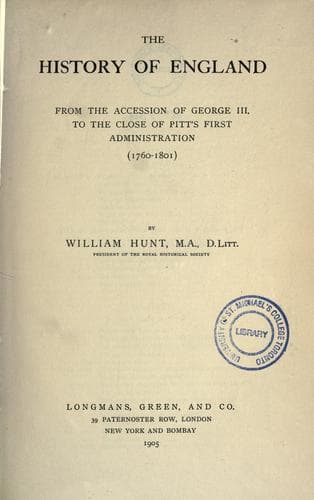
The history of England, from the accession of George III. to the close of Pitt's first administration, 1760-1801Hunt, William
History
The history of England, from the accession of George III. to the close of Pitt's first administration, 1760-1801
Hunt, William
Great Britain -- History -- George III, 1760-1820
The two parties in the opposition, though acting together against the
government, held widely different views. The Rockinghams aimed at a
homogeneous ministry; they represented the aristocratic whig faction,
were the enemies of prerogative, and were strong advocates of American
independence. Shelburne, like his old chief, Chatham, was opposed to
government by party, held that the king should have an interest in the
government, and so far "be his own minister," and like Chatham had been
hostile to American independence.[162] For political reasons, then,
George was drawn to Shelburne, while personally he despised Rockingham
and hated Fox. He invited Shelburne first, and then Gower, to form a
ministry. Both declined. Shelburne could not afford to split with the
Rockinghams; he knew that they could not stand without him, and he
advised the king to send for Rockingham. George would not see Rockingham
himself, and negotiated with him through Shelburne on the basis of
freedom as regards men and measures, and as to the acknowledgment of
American independence.[163] Rockingham formed his cabinet on the 24th.
He took the treasury. Shelburne was secretary for home, Irish, and
colonial affairs; Fox for foreign affairs, the third secretaryship being
abolished; Keppel, who was created a viscount, first lord of the
admiralty; Richmond, master-general of the ordnance; Lord John
Cavendish, chancellor of the exchequer; Camden, president of the
council; Grafton, privy seal; Conway, commander-in-chief; Dunning, who
was created Baron Ashburton, chancellor of the duchy of Lancaster. To
please the king Thurlow was retained as chancellor. Pitt was offered,
and declined, a subordinate office. Burke was treated by his
aristocratic friends as unworthy of cabinet office, and was made
paymaster of the forces.
Public-domain text, read in full here on John Shaqi.
Reviews
Reviews
No reviews yet
Be the first to share your thoughts on this work.
Elsewhere in the archive
Join the Discussion
Join the discussion
Sign in to leave a comment or review.
Sign InorCreate an account