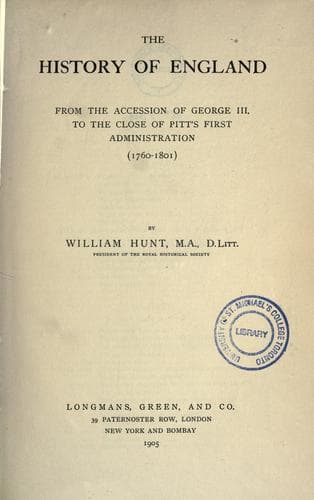
The history of England, from the accession of George III. to the close of Pitt's first administration, 1760-1801Hunt, William
History
The history of England, from the accession of George III. to the close of Pitt's first administration, 1760-1801
Hunt, William
Great Britain -- History -- George III, 1760-1820
Before the Irish parliament met after the Easter recess the Rockingham
ministry came into office; Carlisle was abruptly removed, and the Duke
of Portland was appointed to succeed him. Rockingham, Fox, and Burke
were anxious to satisfy Ireland, but the ministry seems not to have
determined its exact line of policy. An attempt was made to embarrass
the ministers by Eden, Carlisle's chief secretary, apparently in revenge
for their discourteous treatment of Carlisle. Without consultation with
them, he proposed the repeal of the act of 9 George I. which asserted
the right of the king and parliament of Great Britain to legislate for
Ireland. Fox opposed the motion and it was withdrawn. The next day,
April 9, the ministers brought a royal message to parliament
recommending to its consideration means of satisfying Irish discontent.
The spirit manifested in the Dungannon meeting overcame the resistance
of the Irish parliament, and the nation was united in its demands.
Rockingham and Fox tried in vain to persuade Grattan to give them time
for consideration.[165] On the 16th he moved an address to the king in
the Irish parliament asserting independence, and it was carried
unanimously. The ministers, misled by Portland, believed that the Irish
demands might be modified, and proposed negotiation. Grattan refused,
and they yielded everything. On May 17 resolutions, afterwards followed
by statutes, were carried without division in both houses, conceding
legislative independence to Ireland, restoring the appellate
jurisdiction of the Irish house of lords, and limiting the mutiny act.
Ireland thus became almost an independent state. It remained connected
with Great Britain by the tie of the crown, it had no executive
dependent on its parliament, and its legislation was subject to a
ministerial veto. The revolution of 1782, pressed on by Grattan, set up
relations between the two kingdoms which were anomalous and fraught with
danger.
[Sidenote: _THE "BATTLE OF THE SAINTS"._]
Public-domain text, read in full here on John Shaqi.
Reviews
Reviews
No reviews yet
Be the first to share your thoughts on this work.
Elsewhere in the archive
Join the Discussion
Join the discussion
Sign in to leave a comment or review.
Sign InorCreate an account