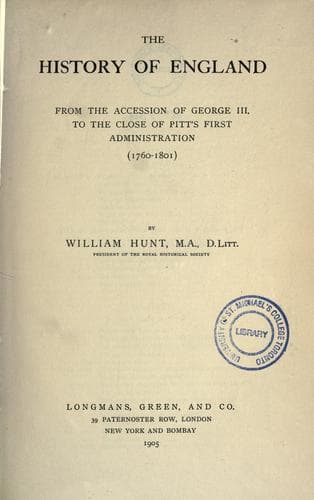
The history of England, from the accession of George III. to the close of Pitt's first administration, 1760-1801Hunt, William
History
The history of England, from the accession of George III. to the close of Pitt's first administration, 1760-1801
Hunt, William
Great Britain -- History -- George III, 1760-1820
Hughes had already taken the Dutch settlements, Negapatam and
Trincomali, when in February a French fleet appeared off Madras to
protect them. It was commanded by M. de Suffren, an admiral of
remarkable ability. Suffren sailed from France in March, 1781. He fell
on an English squadron, on its way to seize the Dutch colony at the
Cape, in the neutral water of Porto Praya harbour in the Cape de Verde
islands. The fight was indecisive, but he arrived first at the Cape and
prevented the projected attack. His fleet was superior to that of
Hughes, whose principal object was to prevent him from gaining a port as
a place of supply and for landing troops. Hughes fought four indecisive
battles with him, and was unable either to prevent the French from
acting with Haidar, or from taking Cuddalore, which gave them a good
naval and military station, or from reducing Trincomali. In this long
and famous naval duel Hughes, though a capable and gallant captain,
showed himself far inferior to Suffren in strategical and tactical
skill. The French admiral, however, was constantly thwarted by the
misconduct of his subordinates, while the English captains gave Hughes
loyal support.[168] Coote carried on the war with vigour, but his
victory over Haidar and his French allies at Arni was rendered fruitless
by his lack of cavalry and supplies. Haidar died in December, leaving a
message bidding his son make peace with the English, which Tipu did not
obey. Coote died in April, 1783. The peace with the Marathas enabled the
English to invade Tipu's country on the Malabar side, where they met
with some success and one signal disaster. Meanwhile Coote's successor,
Stuart, was attacking the French in Cuddalore. A fifth indecisive battle
with Suffren on June 20 compelled Hughes to withdraw his fleet to Madras
to refit. Stuart's army, weakened by disease and in sore need of
supplies, was saved from probable disaster by the news of the treaty of
Versailles. Deprived of his French allies, Tipu was at last, March 11,
1784, persuaded by Lord Macartney, the governor of Madras, to make
peace. By this treaty, which Macartney made against the commands of
Hastings, both parties surrendered their conquests. A renewal of war was
certain, for Tipu's arrogance was unabated.
[Sidenote: _FOX AND SHELBURNE QUARREL._]
Public-domain text, read in full here on John Shaqi.
Reviews
Reviews
No reviews yet
Be the first to share your thoughts on this work.
Elsewhere in the archive
Join the Discussion
Join the discussion
Sign in to leave a comment or review.
Sign InorCreate an account