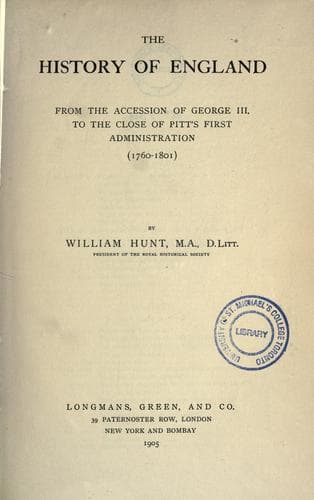
The history of England, from the accession of George III. to the close of Pitt's first administration, 1760-1801Hunt, William
History
The history of England, from the accession of George III. to the close of Pitt's first administration, 1760-1801
Hunt, William
Great Britain -- History -- George III, 1760-1820
The ecclesiastical architecture of the time was deplorable. Towards the
end of the century it was affected by the revolt from classicism in
literature; and a desire was manifested to desert the corrupt following
of classical models for Gothic art, but it was unaccompanied by taste or
knowledge, and the elder Wyatt's sins of destruction at Salisbury and
elsewhere have made his name a by-word. In secular architecture things
were better; Chambers, the architect of Somerset House, Robert Adam and
his brothers, architects of the Adelphi buildings, and the younger Wood
at Bath have left us works of considerable merit. In art, however, our
period is chiefly memorable as that of the development of the English
school of painting. Sir Joshua Reynolds, one of the great portrait
painters of the world, was in high repute in 1760, was the first
president of the Royal Academy, founded in 1768, and independently of
his work did much to raise the appreciation of art, for he was
universally respected. He started the famous literary club of which his
friends, Johnson, Burke, Goldsmith, and other distinguished men, were
members. Scarcely inferior to Reynolds as a portrait-painter,
Gainsborough invested his subjects with wonderful grace, and Romney,
though not attaining to the height of these two, may be reckoned with
them as a master of his art. Before the end of our period Hoppner and
Lawrence were working in London and Raeburn in Edinburgh. The heavy debt
which English landscape painting owes to Wilson, who lived neglected,
has been acknowledged since his death. In that line Gainsborough was
unsurpassed; he was wholly free from classical tradition and, as in his
portrait work, interpreted nature as it presented itself to his own
artistic sense. By 1800 Girtin had laid the foundation of genuine
painting in water-colours, and Turner was entering on his earlier style,
working under the influence of old masters. Humble life and animals were
depicted by Morland, who was true to nature and a fine colourist. In the
treatment of historical subjects classical tradition long held an
undisputed sway; and the chief claim of West, once a fashionable artist,
on our remembrance is that he broke away from it in his best picture,
"The Death of Wolfe," painted in 1771, which represents his figures in
the uniforms they wore instead of dressed as Romans, a revolt which
caused no small stir.
Public-domain text, read in full here on John Shaqi.
Reviews
Reviews
No reviews yet
Be the first to share your thoughts on this work.
Elsewhere in the archive
Join the Discussion
Join the discussion
Sign in to leave a comment or review.
Sign InorCreate an account